
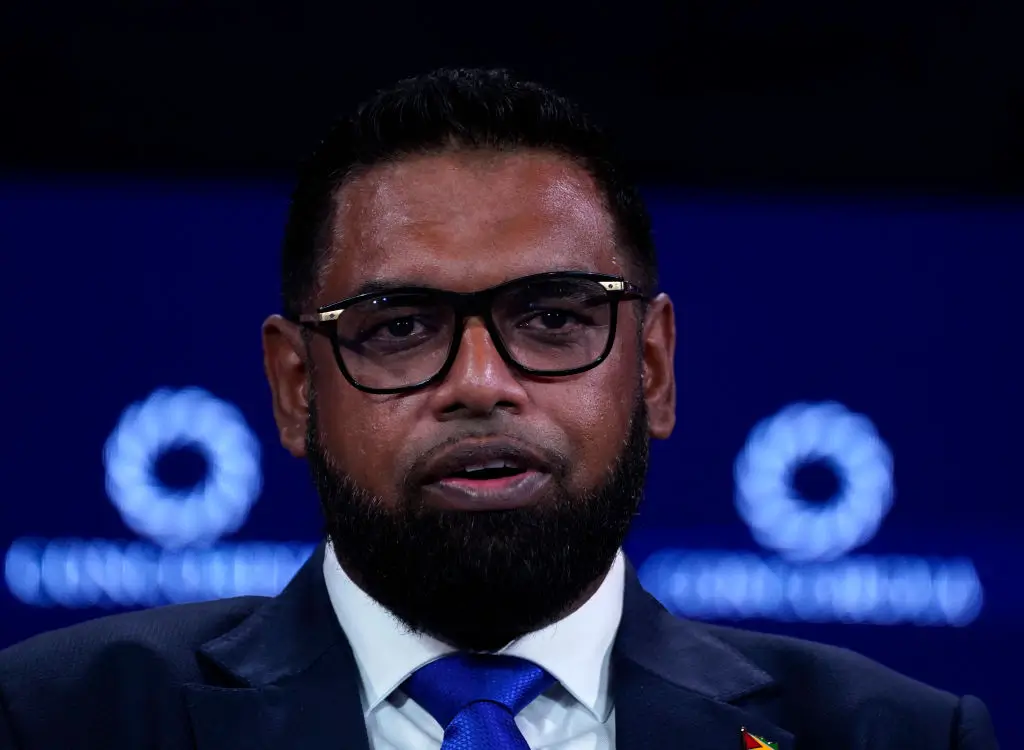
The Guyanese President Mohamed Irfaan Ali reproached a BBC reporter who asked him about the environmental consequences of the South American nation’s offshore oil and gas activity along its coastline, a moment that drew online praise from many who admired how he exposed what some call a standing hypocrisy shaping global perspectives on the climate crisis.
In a sit-down with Stephen Sackur on BBC’s HardTalk, President Ali was quick to respond when Sackur pressed him about the country’s booming fossil fuel sector, which critics say could contribute more than 2 billion tons of carbon emissions to the atmosphere. Sackur also noted that Guyana’s offshore output is expected to generate roughly $150 billion for the country over the next twenty years.
Ali cut Sackur off and redirected the line of questioning, asking Sackur what he knew about Guyana’s forests.
“Let me interrupt you right there. Do you know that Guyana possesses a forest—forever, in the sense that it spans the size of England and Scotland combined? A forest that stores 19.5 gigatonnes of carbon? A forest that we have kept alive,” Ali told Sackur.
“Does that give you the right to release all this carbon?…
“Does that give you the right to lecture us about climate change?” Ali interjected. “I am going to lecture you on climate change because we have safeguarded this forest that stores 19.5 gigatonnes of carbon that you enjoy, that the world enjoys, that you do not pay us for, that you do not value, that you do not see worth in, that the people of Guyana have preserved.”
“Guess what? We have the lowest rate of deforestation in the world. And guess what? Even with our boldest exploration of the oil and gas resources we have now, we will still be net zero; Guyana will remain net zero even after all our exploration,” Ali added.
Ali pressed Sackur further, pointing to what he called an “existing hypocrisy” in the global arena.
“Over the past 50 years, the world has lost 65 percent of its biodiversity. We have preserved ours—are you valuing it? Are you prepared to pay for it?” Ali asked. “When will the developed world pay for it? Or are you in their pockets? Are you aligned with those who damaged the environment? Are you, and your system, in the pockets of those who destroyed the environment during the Industrial Revolution and who are now lecturing us? Are you paid by them?”
A clip of the interview circulated widely, being shared thousands of times across networks.
Many online applauded Ali for drawing attention to the rhetoric around climate change and the so-called colonial mindset that much of the developed world applies to developing nations that extract fossil fuels yet do not emit greenhouse gases at the same rates as Western nations.
As one of South America’s most densely forested nations, Guyana historically depended heavily on eco-tourism as a principal economic engine. Tropical rainforests blanket roughly 90 percent of the country’s land area. Yet, in the past decade, the nation has posted notable economic gains thanks to its abundant oil and gas resources and output.
Oil major ExxonMobil has been expanding its offshore natural gas output in Guyana since giant offshore oil discoveries were made in 2015. By early 2024, the company was producing more than 600,000 barrels of oil per day from drilling 40 wells in a single Guyanese region.
Those operations have brought in more than $3.5 billion for Guyana to date. Data from the World Bank indicate that Guyana ranks among the fastest-growing economies globally, with GDP per capita rising from $6,477 in 2019 to $18,199 in 2022.
This surge of revenue has enabled improvements in the country’s infrastructure and the construction of new schools, hospitals, and highways. Guyana has also invested in a nearly $2 billion pipeline to bring natural gas ashore and supply a reliable electricity source for its people.