
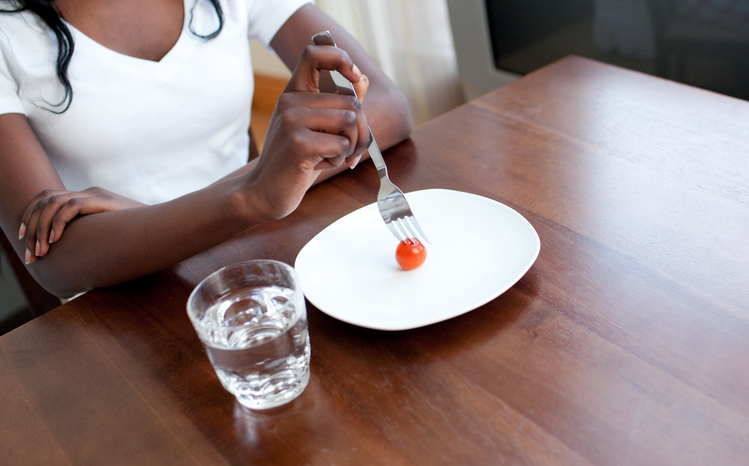
In the late stretch of spring term at Howard University, a cadre of young Black creatives huddles inside a rented Airbnb with cameras rolling and lights blazing. A plate of food is being arranged for the fifth time. At the center stands 21-year-old Na’vaeh Dudley, guiding a story that didn’t originate from theory or imagination but from something far more intimate—her own life.
Her life becomes the muse.
Her short film, Consumption, examines isolation and the intricate, often invisible bond between food and emotion. Yet what gives the project its sharpened edge is its focus on a topic rarely acknowledged within Black communities—eating disorders.
Na’vaeh understands precisely how that silence operates.
“Consumption really explores how isolation can consume us,” she notes. “And how connection can sometimes interrupt that cycle.”
Traditionally, eating disorders have been depicted as a concern that affects white girls and women—slender, well-off, and suburban. Yet that portrayal has always been incomplete and harmful, because Black girls and young women have also grappled with disordered eating. They’ve simply been overlooked.
Research indicates that Black adolescents and teenage girls are 50% more likely to engage in bulimic behaviors than their white peers, yet they are far less likely to receive a diagnosis or treatment. That disconnect between those wrestling with the issue and those who acknowledge it has given rise to a quiet crisis, and Na’vaeh steps into that space with intention.
In Consumption, the central character Nori lives inside a tightly regulated universe. Every moment is scheduled, all habits are deliberate, and every bite is measured. But as her surroundings shift—through the entrance of a roommate, disrupted routines, and human closeness—those patterns start to falter.
Leading actress Shierra King bears that weight with nearly no spoken lines. In one scene, she mulls over a plate of lasagna. Her motions are slight, but they carry a heavy charge. It took nearly five hours of shooting, shot after shot, to secure that single moment. For Na’vaeh, the objective wasn’t merely to tell a story; it was to make people feel something that suits language yet eludes it.
That aim matters, especially when examining how eating disorders manifest within Black communities. Cultural norms around food, body image, and communal life can obscure harmful patterns, making it harder for individuals to recognize what they’re experiencing. In some spaces, eating more is normalized. In others, control is exalted. In many cases, the line between coping and harm becomes blurred. That is the reality Consumption seeks to portray.
Na’vaeh’s connection to the narrative deepened during the COVID-19 pandemic, when isolation became a global condition, but its impact varied depending on who you were and what you carried.
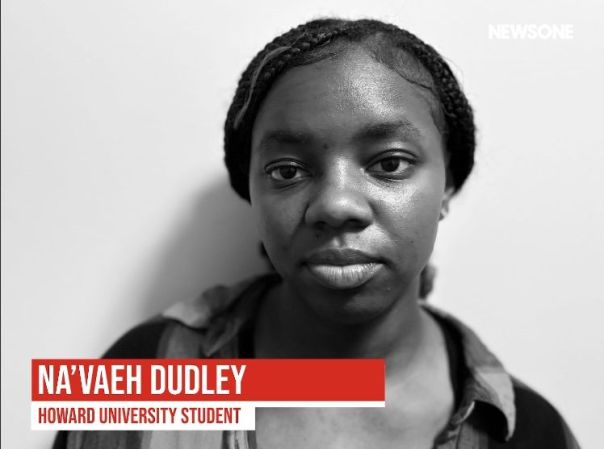
“During COVID, people couldn’t even stay within six feet of one another,” she explains. “Connection, friendship, empathy—those are the things people needed.”
For her, the absence of such connection intensified everything while also quieting it. Filmmaking became a way to process that reality. Yet bringing the project to life came with its own set of obstacles.
It’s a demanding film season at Howard, with MFA students presenting thesis projects and crews stretched thin. Na’vaeh had to construct her team from the ground up by posting casting calls, tapping into DMV film groups, and enlisting friends and collaborators wherever she could find them.
This isn’t just about one film. It’s about what unfolds when Black women begin telling stories that have historically been erased, dismissed, or misunderstood.
Approximately 30 million people in the United States will experience an eating disorder at some point in their lives. Global rates have more than doubled in recent decades. Yet the public face of that data remains overwhelmingly white, leaving Black girls and women navigating these experiences without visibility, resources, or recognition.
Na’vaeh is challenging that narrative—not with statistics, but with storytelling. Her film doesn’t offer a neat resolution. There isn’t a dramatic breakthrough or instant healing, because healing rarely works that way.
“Cures aren’t instantaneous,” she says. “Sometimes the best thing you can do is take a step toward healing.”
That honesty is what gives the project its impact. It doesn’t pretend to fix the problem. It names it. For many viewers, particularly those who have never seen themselves reflected in discussions about eating disorders, that alone can be a powerful turning point.
Na’vaeh Dudley belongs to a generation of young Black women who refuse to wait for their experiences to be legitimized by mainstream narratives. They are documenting them and transforming them into something that can be seen, heard, and felt.
Sometimes the first step toward healing isn’t solving anything. It’s simply asserting, “This is happening,” and knowing you’re not alone.