
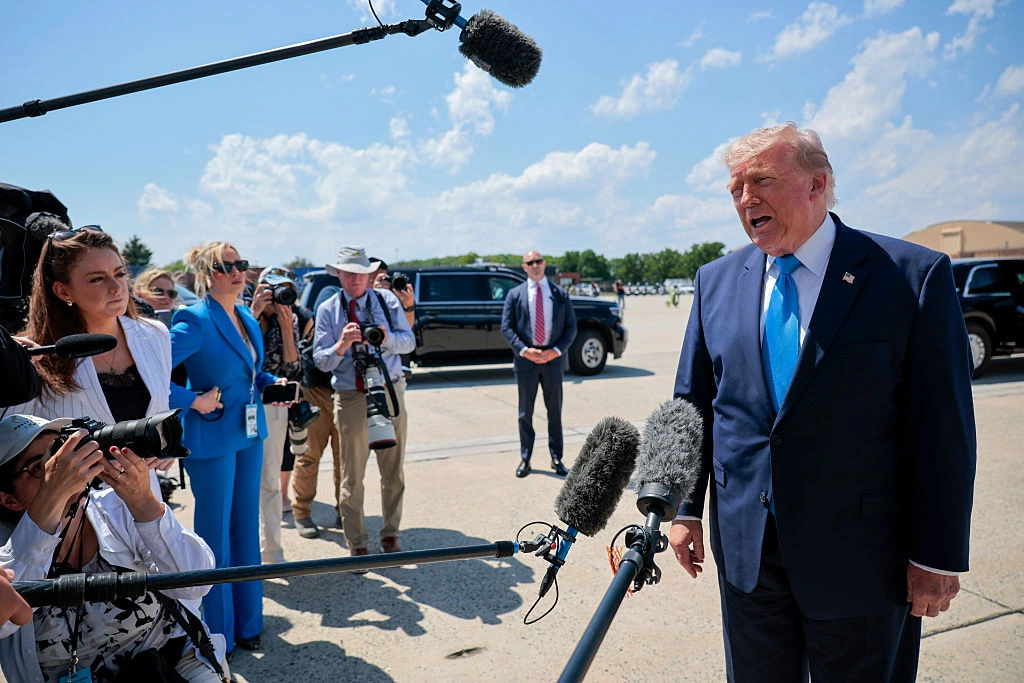
On the tarmac at Joint Base Andrews, President Donald Trump sought to keep the mood light as reporters pressed him about the rapid rise in his wealth over the last year, triggering his familiar accordion‑style hand motions whenever he found himself cornered.
The awkward exchange unfolded after a journalist asked Trump about the billions he’d earned the previous year— profits tied directly to the crypto empire he’s been building with his sons during his second term.
As Trump’s hands continued to move, his replies wandered, dodged, and looped back on themselves.
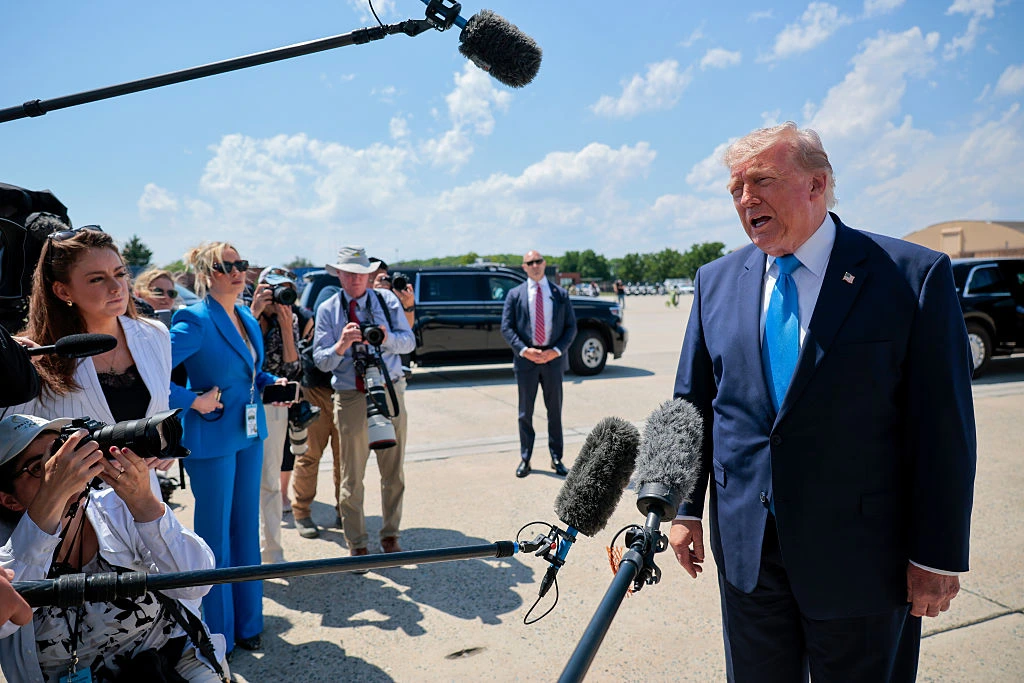
The moment captured a president determined to appear unshaken while standing beside the very family members who helped build the venture now drawing questions about conflicts of interest.
The disclosures just released reveal that Trump raked in more than $2 billion last year, including more than $500 million from a crypto company he co‑founded with Eric Trump and Donald Trump Jr.
The filings rekindled longstanding concerns about whether Trump personally benefits from policies he helps shape.
The gathering on the tarmac, followed by political backlash, underscored that Trump’s effort to distance himself from his own finances isn’t landing as he hoped.
Name One?: Elizabeth Warren Grills Lobbyist on Trump’s Promise Until She Cracks, Then Reveals the Jaw‑Dropping Number Trump Doesn’t Want You to See
‘He Tricked Us All’: Trump Found a Brutal New Way to Punish His Own People — Got Caught Confessing It on Camera, Then Blew His Chance to Walk It Back
The questions began with a straightforward prompt. “Mr. President, your financial disclosure shows you had a very lucrative year last year. What message does that send to ordinary Americans, especially those who are currently facing financial hardship?”
Trump answered, “Well, you know, I don’t involve myself in my finances personally. We have funds that manage my money.”
That’s when the journalist pressed: “But you’re benefiting. We’re talking billions.”
Trump replied with a string of vague remarks.
“Well, I earned a lot of money before becoming president. And they invest my money. I don’t talk to them. I never even speak to them. So I have many people, I don’t know what they call, closed accounts or something. You put your money in, and that’s it. I don’t talk to them. They’re large institutions. And they run it. But yes, I’ve had a great career. In business, I’ve had a great career.”
When asked, “So is that a conflict of interest?” Trump shifted again.
The formal disclosures show a broad and intricate financial picture for the president. The filings indicate Trump earned more than $2.2 billion in the previous year, according to a 927‑page document from the Office of Government Ethics.
The income came from real estate, golf courses, licensing deals, settlements, and a surge in crypto ventures that have expanded dramatically since his return to the White House. World Liberty Financial — the company Trump started with his sons during his 2024 campaign — generated more than $500 million from new crypto products.
Another venture, CIC Digital LLC, brought in more than $600 million from “meme” coins featuring Trump’s likeness. Many of these ventures were startups when Trump took office; now they surpass much of his traditional real estate portfolio.
Trump also earned millions from Trump‑branded Bibles, sneakers, watches, phones, and other merchandise. In the watch category alone, he pulled in $4.7 million. His broader business network drew revenue from overseas properties in nations negotiating with the U.S. over tariffs, military aid, and other issues.
One notable detail in the disclosures is that while most of the 3,711 reported transactions appear to have been handled through brokers, 625 were listed as “unsolicited” trades, meaning the client—rather than the broker—initiated them.
The majority of those trades occurred in March, with activity spiking shortly after the U.S. strikes on Iran.
That disclosure sits uneasily next to Trump’s insistence that he doesn’t speak with the people who manage his money and doesn’t know what they invest in. Although a sizable portion of his portfolio appears to be stewarded by financial institutions, the filings imply hundreds of trades were initiated outside the usual broker‑driven process.
The White House, for its part, maintained there is no conflict. Spokesperson Anna Kelly said, “Neither the president nor his family has ever engaged—and will ever engage—in conflicts of interest. President Trump has tirelessly positioned the United States as a crypto hub through executive actions, backing legislation like the Genius Act and other prudent policies to spur innovation and economic opportunity for all Americans.” She added that any contrary suggestion is part of a “tired, false narrative.”
But outside the administration, the response was markedly different. California Governor Gavin Newsom weighed in on X with a sharp critique, writing, “Trump’s financial disclosures lay bare how his crypto gambit worked: he got richer, while his crypto supporters got rug-pulled.”
Newsom’s post echoed across social media, with critics framing the disclosures as proof that Trump’s crypto push enriched himself far more than those who invested in it.
People watching the online discourse reacted in real time, noting the rapid hand movements and suggesting deception, with comments like, “His hands are flying, he’s lying,” and “Donny looks nervous,” while another observer quipped, “Concertina hands, again.”