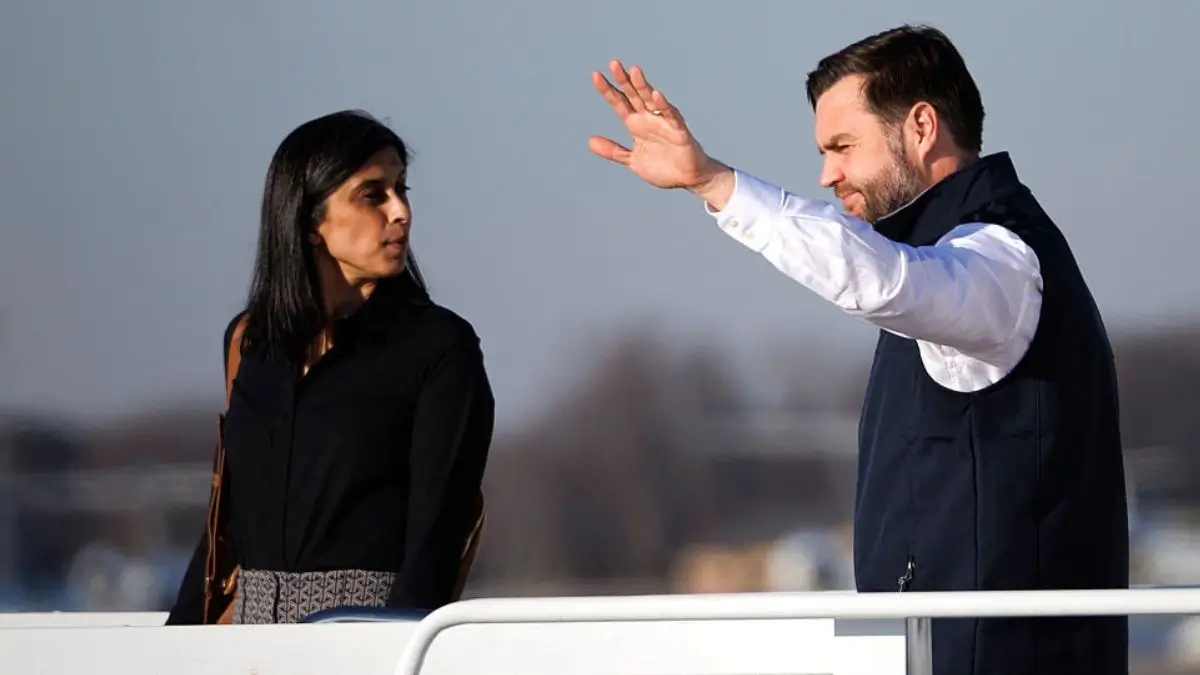
Vice President JD Vance encountered an unusually awkward moment when a man pressed his wife, Usha Vance, with a pointed inquiry.
Vance interjected rapidly with a blunt one-liner that appeared to expose more than he planned.
His reply immediately transformed the encounter from a straightforward exchange into something that read as a protective husband defending his spouse.
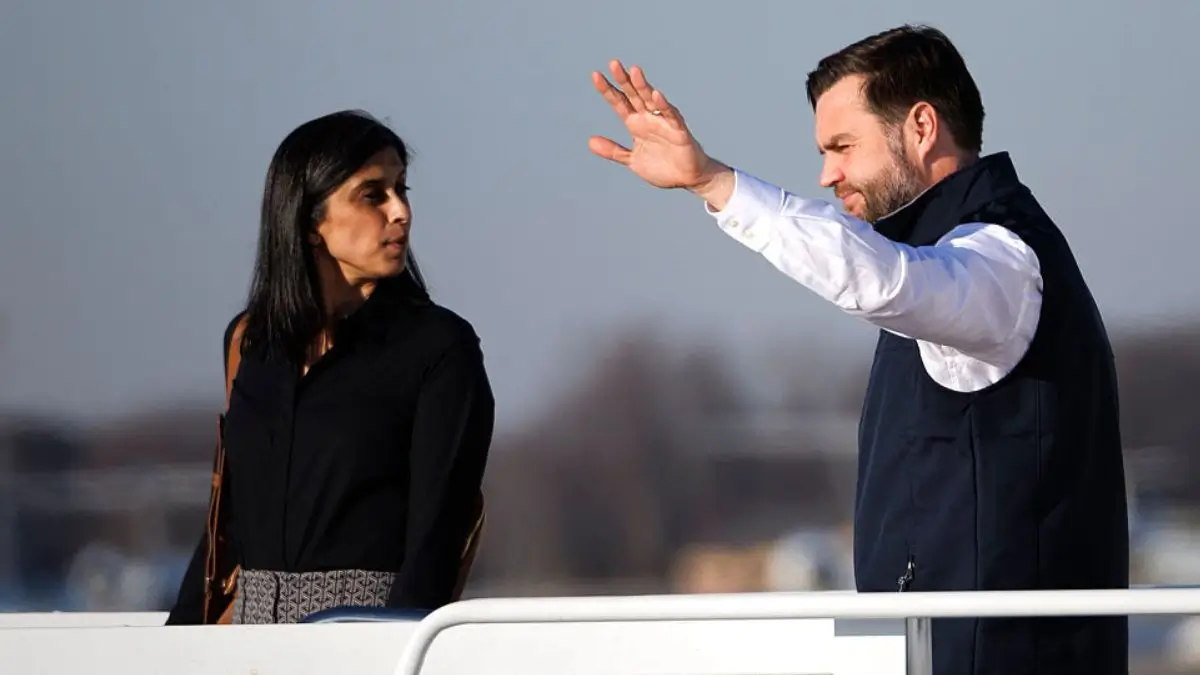
At a rally in Detroit, Vance delivered remarks that drew on the persona of a well-known American actor to address an issue concerning his wife, Usha Vance.
Speaking up in defense of Usha, Vance’s wording resembled closely Will Smith’s 2022 Oscars moment, a likeness that quickly invited comparison.
‘Whoa … ’: JD Vance Shocks His Wife on Live TV with a Controversial Admission — An Indian Celebrity Chef Responds and Places Blame on Usha
His target was Abdul El-Sayed, the Michigan Democrat challenging Rogers. In an instant, onlookers were left asking, “What did he say?” and “Will you echo Will Smith?”
Vance began by attacking El-Sayed’s character.
He told the audience there was “something about Abdul El-Sayed that is very, very evil,” accusing him of privileging one group over all others.
Then he warned, “Keep my wife’s name out of your mouth, because she’s far out of your league.”
Those lines have become among the most replayed quotables of the past decade — yet they are not about policy.
View on Threads
In March, 2022, at the 94th Academy Awards, comedian Chris Rock made a joke onstage about Jada Pinkett Smith’s shaved head, comparing her to “G.I. Jane.”
What Rock hadn’t anticipated was Will Smith, Jada’s husband, striding onto the stage from his seat and striking him before a worldwide live audience.
The star of “King Richard” sat down again and delivered the line that has endured beyond the film he’d won for that night: “Keep my wife’s name out of your mouth.”
Four years later, the expression largely serves as shorthand for a man overcompensating in public, which is exactly how online commentators interpreted Vance’s use of it.
No one online let the distinction pass unnoticed—the insult had been directed at Smith’s wife in front of a crowd.
Will smith slaps Chris rock at the Oscars. pic.twitter.com/QEepWnmTEd
— 👑 (@idollkod) June 30, 2024
Usha Vance had already responded to El-Sayed with a laugh. That was days before her husband decided the matter required further resolution.
Then a flurry of allegations followed: that El-Sayed associates with terrorist sympathizers and that he might have suggested America deserved 9/11. Vance condemned those claims as vile, adding that Michigan voters would evaluate El-Sayed based on his record.
That’s where he pivoted. He argued that Michigan residents find it odd when you discuss another man’s wife and would rather learn about his concrete plans to defend auto workers.
Then, with the crowd assembled: “But whatever you want to discuss, Abdul, keep my wife’s name out of your mouth, because she’s far out of your league.”
Soon after, the clip circulated across social platforms such as X, igniting broad conversation among users.
“Hahaha, not JD borrowing African American slang to sound ‘brolic.’ lol, hush,” quipped one commenter.
“Oh, so now he’s defending his wife. Clown, sit down,” commented another observer.
“Awww, was he aiming for his own ‘Will Smith defending Jada’ moment? Too bad he lacks Will Smith’s intensity—perhaps next time, little guy.”
Yet the most heated online chatter focused not on El-Sayed but on the impersonation Vance had just delivered.
“Will Smith gave that line extra punch,” wrote one X user alongside the rally clip. “JD Vance gave it a slicker polish.”
Others noted why adopting the line felt hollow when spoken by him. “Channeling Will Smith energy against El-Sayed, which is odd,” commented another user.
One user pointed to right-wing figure Nick Fuentes, who hurled an ethnic slur at Usha last year, adding that Vance did little when Fuentes attacked his wife.
Elsewhere, another reader treated the “league” metaphor literally, noting that El-Sayed is a Rhodes Scholar with a doctorate from Oxford and a medical degree from Columbia, suggesting maybe his league is different.
El-Sayed captured Michigan’s Democratic Senate primary on August 4, paving the path to a contest with Rogers for the seat left open by retiring Senator Gary Peters.
About two and a half weeks afterward, Vance appeared in Middletown, Ohio, where he challenged him over earlier remarks about Sharia law—namely El-Sayed’s claim that opposition to it was grounded in white supremacy.
Vance invoked the memory of his late grandfather, saying he wished he could tell him about El-Sayed’s remarks.
“That’s not my Papaw’s Democratic Party,” according to Newsmax.
El-Sayed responded the following day on X, in fourteen words: “So do we think JD is taking Usha with him back in time to meet Papaw, or no…”
Usha Vance is the daughter of Indian immigrants. Critics read the post as implying that Vance’s grandparents might not have accepted her.
That evening, El-Sayed doubled down on MS NOW, arguing his point concerned who gets treated as American.
By then, the second lady had already chosen her course and did not require her husband’s assistance.
During an interview with Rachel Campos-Duffy on Fox & Friends, Usha Vance said she laughed it off to some extent.
She confessed she had never met JD’s Mamaw and Papaw, but she “knows and loves” the children they raised, including his mother, his aunt, and his uncle.
“They have always shown me nothing but extraordinary affection,” Usha added, “and his aunt feels like a second mother to me.”
El-Sayed, who had recently been involved in a tense television debate, responded on Monday without uttering Usha’s name.