
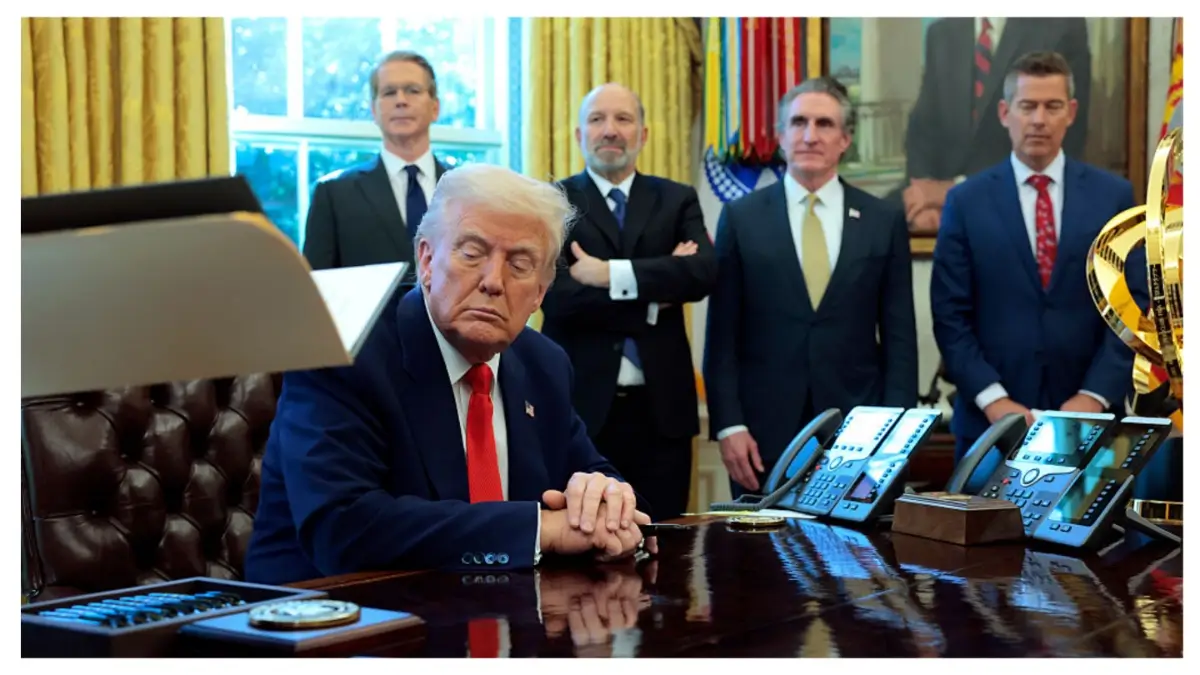
Factional battles inside the Trump administration over who knew what and when, linked to the dramatic downfall of Nvidia’s chief, are now spilling into the public sphere.
On Friday, Treasury Secretary Scott Bessent appeared on national television and accused Commerce Secretary Howard Lutnick of dragging his feet in designating the Singapore-based firm Megaspeed as a national security threat.
Jensen Huang, the founder and now-former CEO of the multi‑billion‑dollar tech giant Nvidia, abruptly resigned on Thursday after reports surfaced about his affair with a Megaspeed employee named Alice Huang. U.S. intelligence believes Alice Huang, who is not related to Jensen Huang, may be a Chinese spy.
There are further suspicions that she may have illicitly funneled restricted advanced AI chips she obtained from Nvidia to China, jeopardizing not only national security but America’s lead in the field.
Against this backdrop, Bessent told CNBC there was broad backing across multiple departments in the Trump administration for blacklisting U.S. technology exports to Megaspeed. Among those backing the ban were the Treasury and State Departments, the Pentagon, and the U.S. Trade Representative, according to CNN.
Bessent then directly placed the blame for delaying a ban on Megaspeed on Lutnick’s shoulders.
“Treasury and my deputy has been pushing for this for months,” he claimed in the interview.
Then he went further.
“Commerce … has the pen. You would have to ask them about their internal processes,” he stated.
He also said the delay in prohibiting Megaspeed exports violated President Donald Trump’s directives.
“I am frustrated that President Trump made it very clear that China should not receive any Nvidia chips above A100s,” Bessent admitted. Nvidia’s A100 chips are considered entry-level, CNN reported, and the AI company is allowed to export that technology.
“And so any leakage is very frustrating because it hurts our great companies in the AI race, gives the Chinese an advantage,” he added. By “leakage,” he means allowing China to obtain more advanced Taiwan-made chips.
The Trump administration has known about this for months, according to news reports, but did nothing. Trump is said to be close to Jensen Huang and has profited from Nvidia.
As for Lutnick, Trump publicly backs his longtime friend for now. But media outlets report that privately the situation may be different.
Sen. Maria Cantwell, the ranking member on the Senate Commerce Committee, sent Lutnick a Sunday letter urging him to block advanced AI chips to firms tied to China.
On Thursday, Senate Banking Committee Chair Tim Scott summoned both Huang and Lutnick to testify before the committee in December.
CNN reports that Lutnick and other senior Trump officials have known about the risks surrounding Huang’s relationship with Alice Huang for months but have taken no concrete action.
As Jensen Huang stepped down as Nvidia’s CEO, another affair came to light, this time with a Nvidia employee.
Part of the concern about Lutnick’s inaction involves his connections to the former Nvidia CEO and other Chinese companies. CBS reports questions about Lutnick’s oversight of billions in Nvidia chip sales.
Before entering the Trump administration, Lutnick led the New York investment bank Cantor Fitzgerald. The bank, under Lutnick, reportedly held more than $1 billion in Nvidia stock, according to CBS.
When he assumed leadership of the Commerce Department, Lutnick took on the duty of monitoring export sales of U.S. technologies to adversaries and rivals.
Under former President Joe Biden, the Commerce Department launched a probe into whether it redirected chips obtained from Nvidia to China.
Under Trump, the investigation was transferred to the Justice Department, which has not commented.