
President Donald Trump appears to have a knack for reworking every corner of Washington’s real estate.
From the White House’s ballroom to the Rose Garden, he has been busy giving the nation’s capital a facelift.
Now, another historic landmark has caught his eye.
This time, Trump’s gaze stretches across Pennsylvania Avenue. And while observers continue to debate the size of his expansive ballroom, the former reality TV star has identified another renovation that could shift costs onto taxpayers.
The timing is drawing scrutiny, as Democrats prepare to assume control of the House in January.
Critics question how much Trump’s push to transform Washington will be changed before opponents can challenge it.
“This quote is so very telling re Trump’s new White House renovations plans. He ain’t planning on leaving peacefully,” one X user wrote, sharing a screenshot from The Washington Post.
The highlighted passage pointed to an interesting detail about Trump’s latest target: Lafayette Square, the historic park directly across from the White House.
According to The Washington Post, the administration is spending roughly $3 million to replace and reset bricks throughout the park. The National Park Service is expected to cover the expense.
Officials claim the renovations will render the park “safe and beautiful.” But the report also revealed concerns that protesters could dislodge the existing bricks and use them as weapons.
Much of Lafayette Square has reportedly remained closed since January, with portions reopening only recently.
And Trump isn’t stopping at the park.
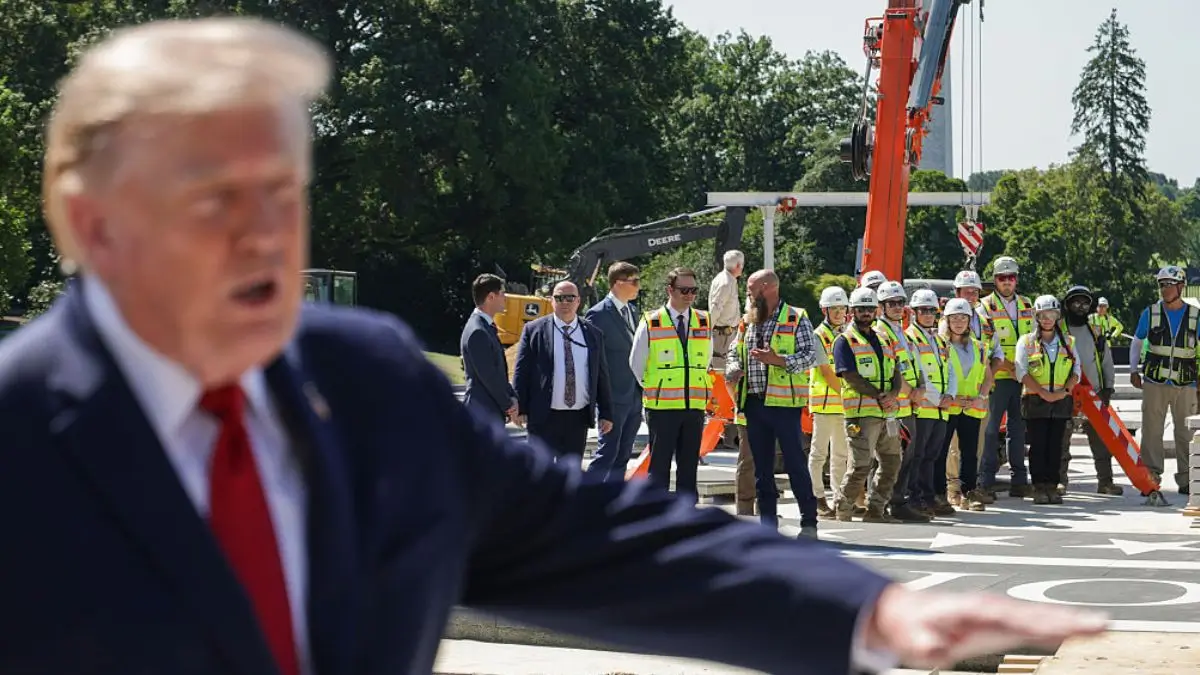
The president is extending a black granite walkway outside the West Wing, pushing it beyond the Rose Garden toward a roadway south of the White House. Construction was underway on Monday as Trump departed for Asia.
His growing collection of projects includes a new visitor screening center, a White House helipad, the paved-over Rose Garden, and the massive ballroom that replaced the historic East Wing.
Then there’s his proposed 250-foot triumphal arch near Arlington National Cemetery and his controversial plan to overhaul East Potomac Park’s public golf course. Federal judges have temporarily blocked both projects.
The publication estimates the administration’s White House construction plans will cost at least $900 million, including projects supported by private contributions.
Critics aren’t exactly applauding his architectural ambitions.
“Trump should have stayed in the private sector if he wanted to manage construction projects,” one Yahoo! News reader complained.
Another reminded the president that the property belongs to the public: “Will someone tell Trump that he doesn’t own the White House, it is owned be the citizens of the United States. He is only a four year tenant.”
A third was already imagining the ballroom’s future: “Looking forward to knocking that ballroom down. Cheaper to maintain that way.”
“STOP HIM from anymore damage to the White House property!!!!” another demanded. One reader joked, “The Oval Office now looks like the parlor of an upscale bordello.”
And another delivered a particularly harsh assessment: “Everything he touches, he ruins. Literally.”
Trump, however, isn’t accepting criticism quietly.
When NBC News correspondent Yamiche Alcindor questioned his construction priorities Monday amid disruptions to the nation’s aviation system, the president lashed out.
“You’re so pathetic. I have a responsibility to make sure the symbol of our country is in decent shape,” Trump responded earlier this week.
“It takes me 10 minutes a day,” he insisted, before declaring, “This is peanuts. And I pay for it.”
That claim raises questions. While Trump says private money is financing certain renovations, the National Park Service is reportedly responsible for Lafayette Square’s $3 million project.
Trump isn’t the first president to leave a construction legacy. His website, TrumpWhiteHouse.archives.gov, details how the people’s house has expanded over the last century.
Theodore Roosevelt oversaw the construction of the West Wing in 1902.
William Howard Taft expanded it and established the first Oval Office in 1909. Decades later, Harry Truman oversaw an extensive structural reconstruction of the White House between 1948 and 1952.
But Trump’s renovation projects have drawn attention for their ambitious scale and increasingly personalized touches.
His ballroom alone is projected to occupy approximately 90,000 square feet, dwarfing the roughly 55,000-square-foot White House. A November photograph shared by White House Deputy Chief of Staff Dan Scavino showed the massive steel framework towering beside the historic mansion.
“Trump’s under-construction ballroom is now bigger than the rest of the White House. Much bigger,” South Carolina Rep. James Clyburn wrote on Facebook.
“The contrast says everything you need to know about this President and his priorities,” he added.
And the construction controversy could soon become an even bigger headache for Trump.
With Democrats preparing to take control of the House in January, Trump’s construction spree could face a new level of scrutiny. Whistleblowers have accused administration officials of destroying government records tied to his renovation projects, prompting Democrats to prepare investigations and potential legal action.
Rep. Jared Huffman, who is expected to chair the House Natural Resources Committee, has already signaled that Democrats intend to investigate the matter.
“Everything is coming; it’s all coming,” Huffman told CNN.
The Interior Department has flatly denied the whistleblower allegations, calling them “100% false.” For a president who recently declared, “I love construction,” the message couldn’t be clearer.
Trump wants to leave Washington looking different than he found it.
But with Democrats preparing to demand answers and Americans questioning the costs, his biggest construction challenge may have nothing to do with bricks, concrete, or steel.
It may be explaining who permitted him to keep building.
Just when you though Trump’s Rose Garden makeover was over, it’s not.
As you know, he paved over the Rose Garden earlier this year. He added some statues, some umbrellas, & the mini Mar-a-lago makeover was complete.
Now, he’s adding BLACK granite borders & REDOING walkways. https://t.co/OCDvTfKVmN
— MP Arizona☀️🏳️🌈💙🌵🐕🐕🦺🫂💦🏜🐟🌴🎙🌎🌻♍️🌊 (@AzPetrich) November 17, 2026