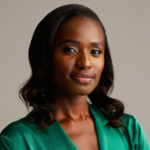
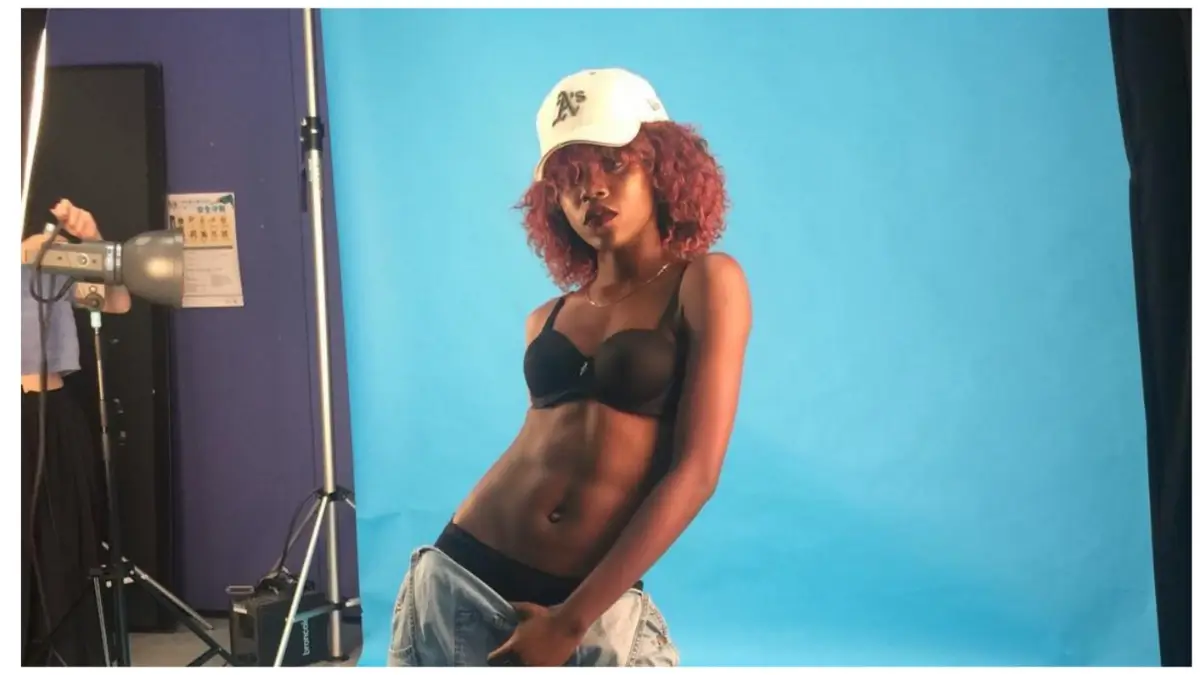
In 2015, Harmony Ilunga, a 16-year-old high school student who dreamed of modeling, walked out of a modeling agency and was overwhelmed by emotion on the bustling, cosmopolitan streets of Hong Kong.
From an early age, Ilunga knew that modeling would be her path.
“If you look at some of my photos from when I was 5 or 8, it’s clear I knew I wanted to be a model,” she told Atlanta Black Star.
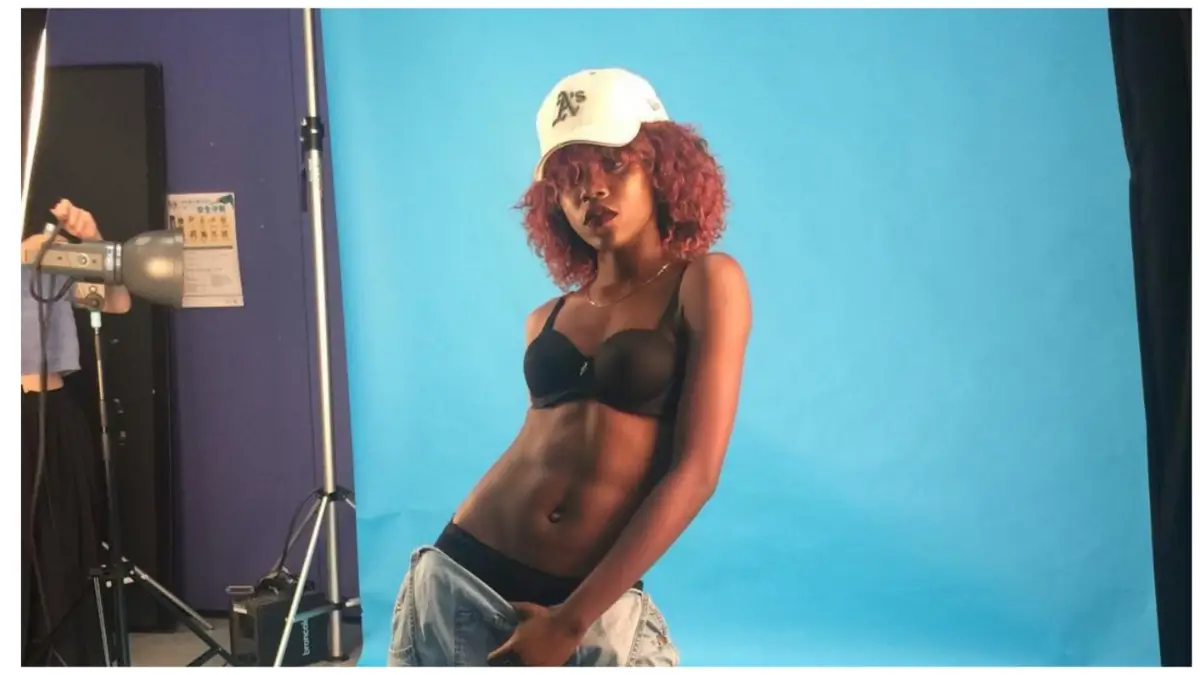
Despite numerous efforts to gain representation from a modeling agency, she faced rejection, and the barrier was her skin color.
Ilunga arrived in Hong Kong as a refugee from the Democratic Republic of Congo in 2011 and spent her formative years there. The 25-year-old barely remembers life back in Congo. To her, she was a Hong Konger. Yet from an Asian standard of beauty, she did not fit the mold.
“This lady [from a modeling agency] literally told me that they don’t hire Black models. And another one, they said, ‘Oh, you’re not what the clients are looking for.’ Another comment was from somebody who is a fashion brand designer, who told me that she works with clients who said, ‘When you use a Black model, it looks cheap. Your brand looks cheap,’” Ilunga recalled.
As a teenage dreamer eager to realize her ambitions, those remarks took a heavy toll. She began purchasing and using market-available cosmetic bleaching products.
“If you look at my high school photos, I was super pale. I was using skin-lightening products to meet the beauty standards they were looking for,” she said.
Even then, landing paid modeling gigs proved difficult. Throughout high school, she struggled. She modeled for free for almost three years to chase her dream.
“I started by helping my friend’s sister. Then, some people were looking for models to start their own fashion brands, and they needed a Black model,” she explained.
The first time she received payment was a modest HK$100 for a school project, but it marked a meaningful milestone for Ilunga. Gradually, as she navigated the local fashion scene with the aid of friends’ recommendations, she began getting paid for her work.
The Evolution of Hong Kong’s Fashion Landscape
Forecasts suggest Hong Kong’s fashion market could generate about US$9.23 billion by 2024.
Moreover, projections indicate a rapid expansion, with the market reaching roughly US$15 billion by 2029 and the number of fashion consumers in the region rising to about 5.6 million by the same year.
Veteran fashion photographer and multimedia artist John-Paul Pietrus has collaborated with Shanghai Tang, a Hong Kong-based luxury fashion house.
“From my perspective, Hong Kong’s fashion press has typically been more of a follower than a trendsetter. Regarding the visibility of Black models in the media here, it has been nearly nonexistent, from what I’ve observed. I did shoot Rob Evans for the Manifesto magazine cover back in 2013, but that’s a rarity,” Pietrus said.
Rise of Mainland China
Before the 1997 handover, under the framework of “one country, two systems,” Beijing and London agreed to preserve the region’s political autonomy for fifty years. Beijing promised that Hong Kong would maintain its capitalist system and enjoy freedoms not available in mainland cities, granting the city five decades to ease into a new order.
Even with fashion progress, Hong Kong now faces stiff competition from the mainland. The zero-Covid policy has kept many travelers away, curbing a sizeable share of luxury spending.
According to a PwC report from February 2023, prior to the pandemic, Hong Kong was seen as a more Westernized and accessible destination than mainland China, making it attractive to luxury brands.
However, in 2021 the spotlight shifted to the mainland, with 55 percent of the world’s new luxury stores opening there.
“Back then [in the early 2000s], China was still developing its fashion voice, which is very developed now. There’s now a huge photographic, styling, and fashion community there. But at that time, it was still developing,” Pietrus noted.
A Sino-African Fashion Influence
Compared to the United States, China maintains a markedly different dynamic with the Black diaspora and Africa.
Much of the Black population in China is either there for business or education.
Some of the first Africans to settle in Hong Kong arrived in the early 1990s to conduct business. Over time, they shifted into brokers for other African entrepreneurs seeking access to the Hong Kong market. Yet Hong Kong has not retained the same appeal since China joined the World Trade Organization in 2001.
Despite these developments, Ilunga’s experiences illustrate that the Chinese fashion industry and wider Chinese society were not eager to broaden the talent pool. Yet a few progressive voices managed to spark positive changes in the early 2010s.
In 2012, Sudanese-Australian model Ajak Deng became the first Black model to grace the cover of a Chinese fashion publication, Modern Weekly.
“It was a huge sensation, partly because Ajak was the first Black model to appear on the cover of a Chinese publication and because of her amazing Comme des Garçons dress. It was a striking image and caused quite a stir,” Pietrus, who shot the image, recalled.
Establishing A Voice of Her Own
Meanwhile, after years of hardship, Ilunga began to land bookings from major brands and realized for the first time that a modeling career could be within reach.
Still, agencies remained reluctant to sign her, so she operated as a freelancer until 2020.
“Observing what was happening in the industry, I decided it was time to launch [a modeling agency]. I started [in 2018] by raising awareness through organizing a biannual fashion show at a club. I wanted to highlight the Hong Kong fashion scene and showcase the talents of refugees and ethnic minorities,” she explained.
“We are being overlooked. I believe actions speak louder than words, and I wanted to show the value these diverse individuals could bring to society. Rather than merely speaking out or protesting, I planned to present their talents through a fashion show. These people were born in Hong Kong and can contribute to Hong Kong’s society,” she added.
In 2020, she launched HarmonyHK to advance her mission of promoting inclusivity and diversity in the local fashion ecosystem.
Today it represents 45 models.
“We have local Hong Kongers, mixed Black and Asians, Westerners, Indians, Pakistanis, Nepalese, Filipinos, and some Black models from Burundi. We also include plus-size models,” she said.
She mainly collaborates with clients selling Korean goods in Japan and with local Hong Kong brands.
The agency has teamed up with major brands like Fenty Beauty, Lululemon, and Esprit.
“I never anticipated the growth we’ve seen; I think we’ve done a solid job,” she remarked.
The Influence of the Black Lives Matter Movement
The actual shifts in the global fashion industry, including Greater China, began in earnest after Black Lives Matter gained momentum in the United States, drawing attention to numerous cases of racially motivated violence by police and others against Black people. In 2020, the killing of George Floyd in broad daylight propelled the movement onto the world stage.
For Pietrus, Floyd’s murder felt personal.
In the early 1990s, Pietrus studied at the Minneapolis College of Art and Design, in the Whittier neighborhood where Floyd died. He recalled the racial tensions between police and non-police, particularly non-white communities.
He was stunned that the situation had hardly changed and that the tension persisted, culminating in the tragic death of George Floyd.
Suddenly, there was a surge in demand for Black models, Ilunga noted.
“I received many messages from people who simply wanted to cast me as a Black model to appear aligned with the movement. Because, you see, many brands were being questioned, ‘Oh, we never see you support Black models.’ So, many brands were eager to work with Black models,” she recalled.
However, she pointed out that many brands entered the space without knowing how to navigate it properly.
HarmonyHK offers diversity and inclusion consulting because Ilunga believes it’s important to have someone from the industry to guide them, explain how things are done, and ensure brands aren’t using Black models merely because everyone else is doing so at the moment.
Things changed dramatically in the Greater Chinese fashion arena.
At the time, HarmonyHK was the only local Black-owned and Black-led modeling agency focusing on diversity and inclusion.
“I think it was an eye-opening moment for many brands in Hong Kong to push further and embrace more inclusivity in their brands because many of them also market to America. So, you have to reflect who your customers are,” she said.
“I have to say, in the decade I’ve lived in Hong Kong, that was the moment when we began to be seen,” she added.
She also received countless messages from parents thanking her for sharing her story and for driving a more inclusive local fashion scene.
“They said, ‘Thank you. My kids now feel seen,’” she said.
After Floyd’s daylight murder, many brands issued promises and launched diversity programs. Ilunga feels that the momentum faded with time.
“Local brands still hire models from ethnic minority communities, including Black or part-Black models, but the peak of change was in 2020 when #BlackLivesMatter was everywhere. Since then, things have cooled down,” she explained.
Having spent substantial time in the industry, Ilunga has noticed that Asian brands targeting Western markets tend to employ a more inclusive and diverse range of models.
“The brands aiming at Asian markets are not as inclusive,” she explained.
Pietrus observed that, regarding diversity, China is presently very China-centric.
Shifts and Hurdles
Despite persisting issues, Ilunga is glad Hong Kong is now open to dialogue.
“That’s progress. We can begin slowly; we can’t expect everyone to change overnight, but simply having this conversation is a major step forward,” she said.
Currently, Ilunga, a model and entrepreneur, resides in Toronto, Canada, where she is developing a new tech startup intended to work alongside HarmonyHK and to expand her enterprise across West and East markets.
“Hong Kong remains heavily influenced by Western culture. So, when I obtained permanent residency in Canada, I decided it was time to push HarmonyHK beyond Hong Kong,” she explained.
She isn’t actively recruiting for her agency at the moment but plans to resume soon. Ilunga aims to travel between Hong Kong and Canada to broaden their network and grow the organization.
The landscape has evolved considerably since Ilunga first started modeling, yet she concedes there is still work to be done. She notes some reluctance around public perception, though she acknowledges substantial improvements.
“There are still reservations, but it’s not what it used to be. I can say that with honesty,” she remarked.