
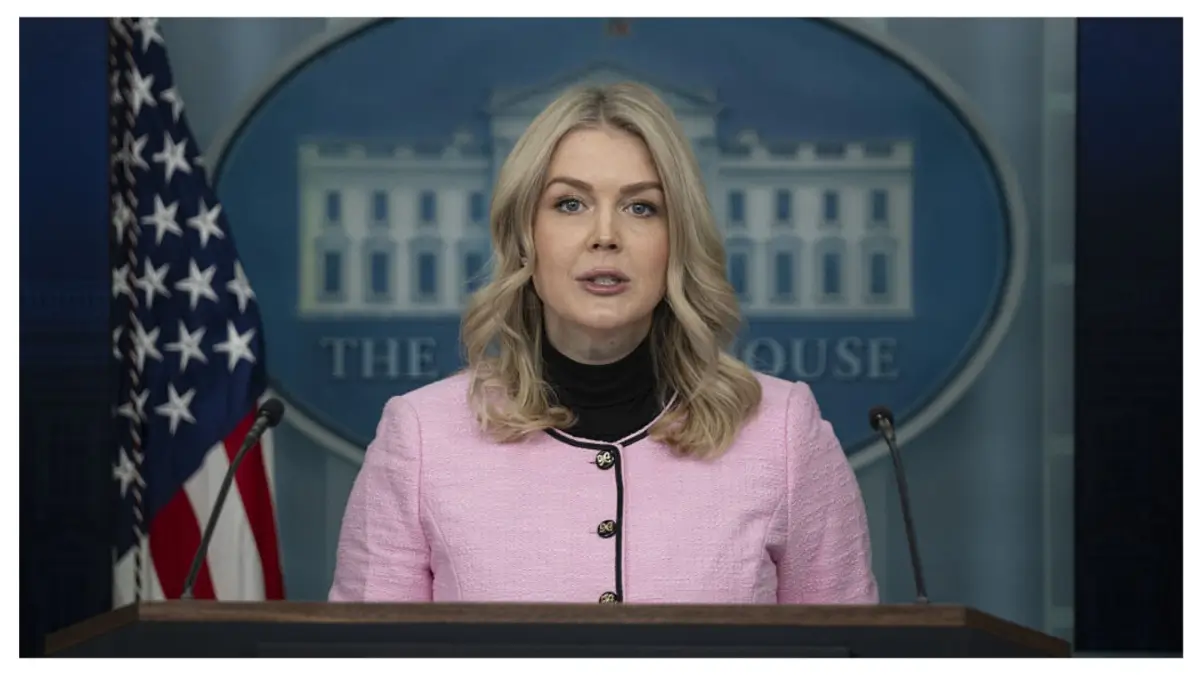
White House Press Secretary Karoline Leavitt believed she could silence the critics of Donald Trump’s confrontation with Iran by asserting that the president possessed “strong and compelling evidence” that Tehran represented an imminent threat to the United States.
Instead, critics say she inadvertently reminded everyone of something awkward.

Only days earlier, while attempting to counter an ABC News report about the war, Leavitt had presented the opposite stance, contending that Iran had not actually posed a direct threat to the United States.
Shortly thereafter, the administration’s own counterterrorism chief resigned, echoing the same view.
‘He Has Lost His Mind!’: Trump Walks Right Into a Reporter’s Trap, Never Realizes His Desperation Is Being Used Against Him — and What Comes Out Next Turns the Room Against Him
Nevertheless, Leavitt doubled down, arguing that Trump’s decision to launch the operation in concert with Israel rested on intelligence from multiple sources and was essential to prevent what she termed the world’s leading state sponsor of terrorism from expanding its missile capabilities and pursuing nuclear weapons.
She also rejected Kent’s assertion that the president had been pressured into the conflict, insisting that Trump alone decides what constitutes a national security threat and that his choice aligned with his long-standing stance that Iran must never be allowed to acquire a nuclear weapon.
The explanation arrived just as Leavitt was already facing online scrutiny for promoting the administration’s take on the war.
Leavitt, who has emerged as one of the administration’s most forceful defenders, has spent weeks attacking reporters and accusing “left-wing” journalists of spreading misinformation about the conflict.
Her latest attempt to steer the narrative came on Tuesday when she shared a supportive op-ed about the war.
“Must Read @WSJ op-ed on the overwhelmingly negative coverage on Operation Epic Fury in Iran, which continues to be a highly successful military campaign against a terrorist regime,” Leavitt wrote.
“We are combating the Fake News daily at the White House, and it’s safe to say the American left-wing media is sadly rooting for President Trump, and therefore the United States Military, to fail.”
But the narrative began to fall apart almost immediately.
Moments before Leavitt posted the message, Kent disclosed he was stepping down from his role in protest of the war.
“I cannot in good conscience support the ongoing war in Iran,” Kent wrote in a post alongside his resignation letter. “Iran posed no imminent threat to our nation, and it is clear that we started this war due to pressure from Israel and its powerful American lobby.”
The timing was brutal.
Within minutes, critics flooded Leavitt’s comment section with screenshots of Kent’s letter, pointing out that the administration’s own counterterrorism chief had just undermined the central justification she was pushing.
“Every time something is labelled ‘highly successful’ while criticism is dismissed as ‘fake news,’ it’s usually because reality isn’t cooperating with the script,” wrote one X user.
Some critics even suggested Leavitt should join Kent in leaving the administration.
“Instead of standing at that podium and lying in support of a traitor, you should resign just like this honorable man did,” one commenter wrote.
“Can’t you tell when you’re doomed? It’s over, you might as well resign now,” another person added.
Kent is far from a fringe critic.
A former Green Beret and veteran intelligence operative, Kent spent years in conflict zones and advised U.S. military operations on counterterrorism strategy. His standing in the national security community made his resignation particularly jolting.
He later became a divisive political figure aligned with the Trump-era “America First” foreign policy, frequently arguing that the United States should avoid costly overseas wars driven by foreign interests.
In his resignation letter, Kent argued that Trump had been misled about Iran’s threat.
“Early in this administration, high-ranking Israeli officials and influential members of the American media deployed a misinformation campaign that wholly undermined your America First platform and sowed pro-war sentiments to encourage a war with Iran,” Kent wrote.
“This echo chamber was used to deceive you into believing that Iran posed an imminent threat to the United States, and that should you strike now, there was a clear path to a swift victory.”
Kent’s departure left critics stunned.
The very official charged with overseeing the nation’s counterterrorism operations was now publicly accusing the administration of launching a war based on exaggerated threats and outside pressure, a claim that immediately undercut the message Leavitt was trying to push.
Leavitt’s response drew more than 22,000 replies on X. Public reaction quickly split along familiar political lines. Trump supporters praised the strikes as a textbook example of his long-promoted “peace through strength” doctrine and pointed to his decades-long warnings that Iran should never be allowed to develop nuclear weapons.
Critics, however, seized on the growing contradictions in the administration’s messaging, accusing officials of exaggerating the threat, while others online agreed the decision reflected pressure from Israel rather than a clear and immediate danger to the United States.
“So either you lied a few days ago or you’re lying now. Which is it?” one person asked. “This is really awkward, Karoline,” another user wrote.