
Hakeem Jeffries, the New York representative, has moved closer to assuming the role of House majority leader as the upcoming Congress prepares to convene in January.
In a confidential ballot held on Wednesday, 251 members of the Democratic caucus backed Jeffries, potentially making him the first African American to hold the post, with 11 opposing his nomination.
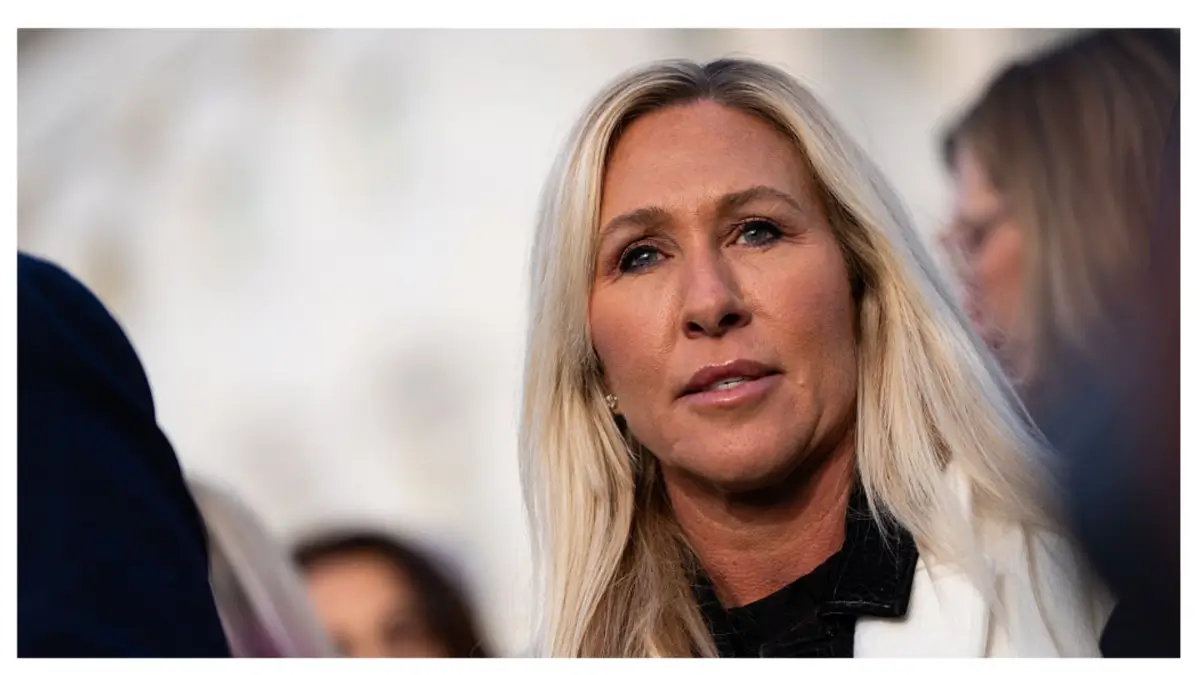
Former Georgia representative Marjorie Taylor Greene offers her own take on why, despite the public calling for sweeping changes in the midterms, the House nevertheless chose Jeffries.
He has wielded influence for more than ten years, having taken over as the leading Democrat in the chamber after succeeding Nancy Pelosi four years earlier.
Greene maintains that the so‑called blue wave in the midterms reflected a desire for change among voters, and asserts that the prospective Democratic leadership quashes that expectation.
As a former MAGA ally, she claimed in a TikTok video the day after the vote that much of both parties’ leadership is beholden to AIPAC, implying they lack the capacity or the will to push real change.
AIPAC, the American Israel Public Affairs Committee, is a lobbying body devoted to bolstering the U.S.-Israel relationship. The organization, founded in 1954, explains on its own site that it is funded by Americans.
It presents itself as a body that lobbies Congress on matters including security aid to Israel, cooperation on missile defense, and broader policy in the Middle East.
It pours millions of dollars into campaigns of both parties to influence U.S. policy in a pro-Israel direction.
In her message, Greene first highlighted the secrecy of the votes by which both parties designate their leaders.
Across both the Democratic and Republican caucuses, voting is conducted behind closed doors.
“The identities of the voters remain undisclosed,” she stated.
The Democrats nominated Jeffries for speaker by a sweeping margin, with no rivals stepping forward.
“That outcome was a huge disappointment for many of the party’s core voters who had backed calls to end involvement in Iran, curtail support for Israel, reduce living expenses, and other priorities,” Greene noted.
“Hakeem Jeffries enjoys robust backing from AIPAC, with millions in funding, and he reportedly met with Jared Kushner prior to the midterms,” she continued.
“Thus, regardless of which candidate you choose, you still end up with Jared Kushner, which is telling, since you continue to encounter pro-Israel positions,” the Republican added.
Jeffries reportedly held a private discussion with Kushner, Trump’s son-in-law and a Middle East negotiator, several weeks ahead of the November midterm. He declined to disclose the topics of their conversation after the media carried the report.
Democrats also chose Massachusetts representative Katherine Clark to serve as the first female majority leader and California’s Pete Aguilar as the party whip.
Greene asserted that AIPAC backs Clark with substantial funds and claimed the group also backs Aguilar, whom she labeled another establishment Democrat.
“So many voters who sought change during the midterms may end up seeing little of it, because these leaders are heavily financed and all politicians, regardless of party, answer to their donors.”
Online commentators expressed astonishment that they could find themselves agreeing with Greene, once a staunch MAGA ally and Trump supporter.
“I never expected to agree with MTG,” declared a Threads user.
Another criticized AIPAC directly.
“AIPAC must go! We need to take our country back!!”
More comments followed.
“We didn’t vote for the same old, spineless politics.”
Jeffries has endured criticism regarding his corporate relationships and his ties to AIPAC. Detractors question the impact of about $1.7 million in campaign contributions from pro-Israel PACs and individual donors on his political profile as a New Yorker.
In another aside about PAC money and lawmakers’ connections to donors, when the House considered impeachment articles against Defense Chief Pete Hegseth soon after the midterms, eleven Democrats were absent for the vote.
All of them have accepted campaign funds from AIPAC.
The impeachment resolution failed 211-204, a result that might have shifted if those who abstained had voted yes.
The entire House is set to vote on Jeffries’ bid for the speakership when the new Congress convenes on January 3 of the coming year.
View on Threads