

They’re the only refugee group that has drawn Donald Trump’s sympathy — white South African residents granted asylum by the president who described them as victims of “egregious” persecution by their government because of their race.
On February 7, Trump issued an executive order that “directed government officials to prioritize the resettlement of South Africans of European descent through the U.S. refugee program, which he suspended during his first day in office.”
The president cited a South African law that permits some expropriation of land without compensation to the prior owners, most if not all of whom had secured their privileged position under the racist apartheid regime that ended in 1992.
Trump has misrepresented the law as a measure to persecute white Afrikaners by seizing their farms without compensation.
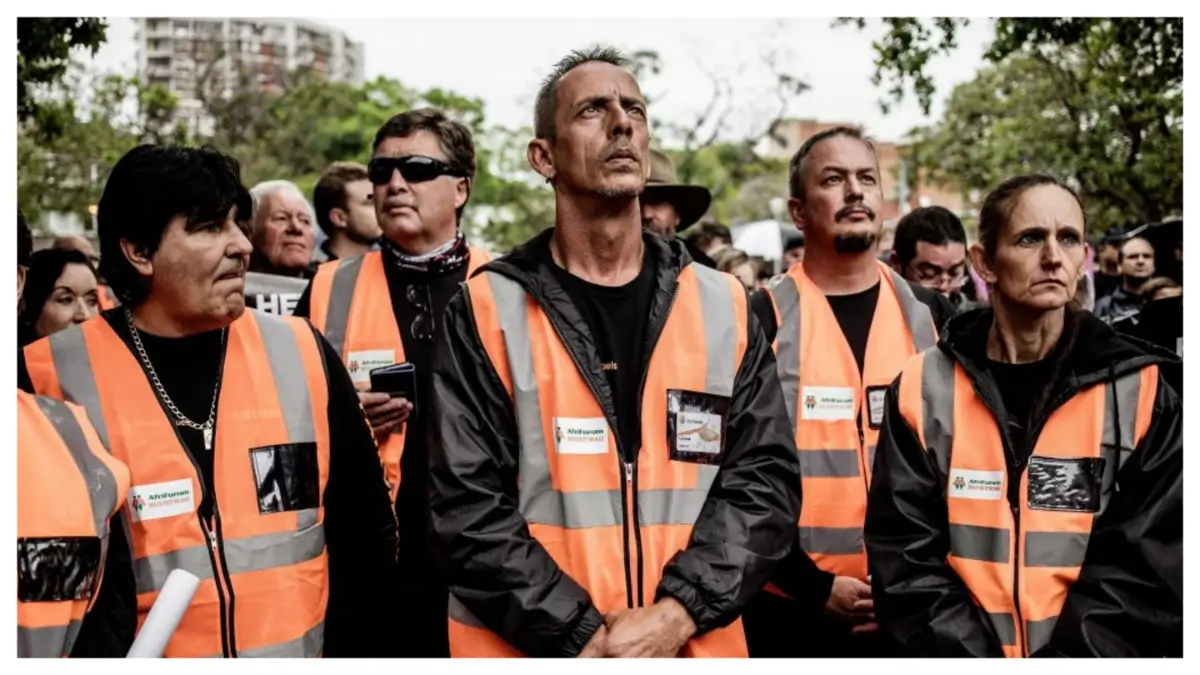
His decision followed seven years of lobbying by AfriForum, whom The Southern Poverty Law Center describes as “white supremacists in suits and ties.” The group is also acting on behalf of the business interests of South African native Elon Musk, who has shared their unfounded claims suggesting an imminent genocide against whites, reports The Guardian.
Insiders say Musk seeks to skirt laws preventing him from selling his Starlink satellite network in South Africa, which requires foreign investors in the country’s telecoms sector to provide 30 percent of the equity in the South African arm of the enterprise to Black-owned businesses. The aim of the law is to uplift people of color oppressed by apartheid by mandating that major business deals include Black investors.
Musk, who grew up during the era of apartheid, has accused South Africa of “openly racist ownership laws.” AfriForum likewise contends that Starlink is being blocked from operating in South Africa because it is “too white” and is subject to “strict race-based criteria.”
Musk and AfriForum have woven together the slayings of white farmers, the nation’s land redistribution laws, and affirmative-action policies into a single narrative that accuses the state’s ruling African National Congress of endorsing persecution of racial minorities.
AfriForum has dismissed apartheid as a “so-called” historical injustice. Its chief executive, Kallie Kriel, maintains that apartheid was not a crime against humanity because not enough people were killed during the decades of white minority rule.
South Africa’s Truth and Reconciliation Commission determined there were 7,000 political deaths under apartheid between 1948 and 1989, with 73 of those deaths occurring in detention camps under the security police. More than 19,050 people were victims of gross human rights violations, the commission found.
But for AfriForum, whites remain the true victims. They began lobbying the first Trump administration in 2018 after the ANC initiated a land redistribution plan.
Kriel and his deputy, Ernst Roets, highlighted what they described as the “persecution of South Africa’s minorities” by exploiting the country’s high murder rate.
Yet unlike neighboring Zimbabwe, where President Robert Mugabe unleashed violence against white landowners in the early 2000s in a land redistribution plan designed to bolster his unpopular regime, South Africa’s white farmers weren’t targeted by the government but were simply victims of the country’s elevated crime rate.
None of the white South African farmers who were murdered subsequently had their land confiscated.
Nevertheless, those facts proved inconvenient to AfriForum’s campaign, which found a receptive audience among white nationalists such as Tucker Carlson. During a segment on Carlson’s Fox News program, Roets claimed Afrikaner farmers were being “tortured to death on farms in unusual ratios.”
Among those watching that evening was Donald Trump, who tweeted an instruction to his then-secretary of state, Mike Pompeo, to “closely study the South African land farm seizures and expropriations and large scale killing of farmers.”
The president went on to describe it as “a massive Human Rights VIOLATION, at a minimum and is happening for all to see.”
In September, at the height of Musk’s dispute with the South African government, AfriForum launched a campaign on his behalf asserting that Black empowerment laws were making white farmers more vulnerable to attacks because they lacked the proper communications Starlink could provide.
“By prohibiting Starlink from operating in South Africa because of racist criteria, [the government] is depriving rural communities of a reliable alternative that may save lives,” the group asserted.
South Africa’s president, Cyril Ramaphosa, phoned Musk the day after Trump signed his executive order in an attempt to defuse tensions. The country’s communications minister suggested exempting Starlink from the Black empowerment rules, but other government members objected, and they are unlikely to be swayed by Trump’s intervention, according to The Guardian.
Meanwhile, Afrikaners, aware that the president’s backing brings them closer to achieving their goal of overturning the current government and re-establishing the era of white minority rule, have rejected the president’s resettlement offer.