
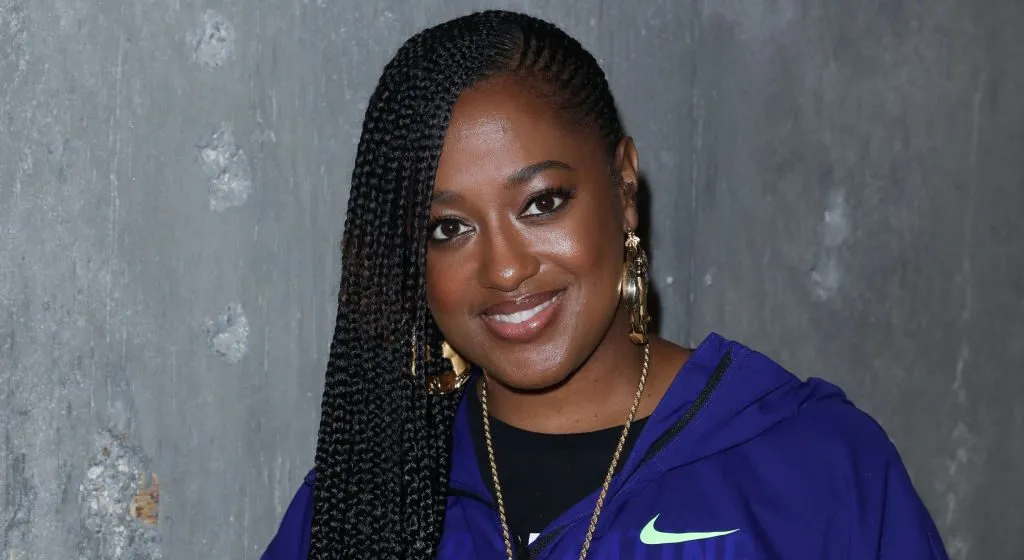
Over the past twenty years, Rapsody has traversed substantial ground, moving from a promising newcomer to earning broad industry recognition that is long overdue. Her newest release, God Gotta Afro & Gold Hoops, stands as both the culmination of a meticulous artistic maturation and a striking affirmation that Black identity is something to be celebrated, not restrained or minimized.
Known endearingly as Rap among colleagues and listeners, she captured her inaugural Grammy last year in the Best Melodic Rap Performance category for the track “3:AM” with Erykah Badu. Her most recent album, Please Don’t Cry, which includes “3:AM”, marked a departure from her earlier work by removing the production influence of her longtime mentor and Jamla chief, 9th Wonder.
Listeners of that project were granted a glimpse into the inner workings of Marlanna Evans, Rap’s birth name, as she unveiled a level of vulnerability seldom seen from someone with her high caliber.
Prior to that release, Rap had come to symbolize the epitome of “Real Hip-Hop” for women— a label loaded with significance yet ultimately hollow, dividing audiences instead of uniting them. She resisted narrowing her scope to fit any single audience, and in doing so she may have alienated some supporters who expected her to champion a singular, canonical sound. By centering herself on Please Don’t Cry and embracing a broad palette of production, she dodged the mantle of “savior” that some supporters projected onto her.
That same trajectory continues with God Gotta Afro & Gold Hoops. Guided by Denaun, aka Mr. Porter, the record centers on a straightforward idea: recognizing the divine in Black music, culture, and in one’s own existence. In Rap’s eyes, Black identity is a sacred honor and a reflection of the sacred.
She continually asserts that Blackness can be defiant and outspoken, yet also refined and diverse. The album presents a spectrum of perspectives that hooks the audience instantly, as the soundscape—rich with soulful singing, affirming refrains, poetry, and unyielding energy—keeps its momentum.
The opener “Peace, God!” establishes the mood, smoothly transitioning into the club-ready “Free Yo’ Mind,” which gracefully folds into a chorus of gratitude and introspection. Then comes “No Way,” highlighted by KARABA YA MORENO’s gospel choir textures; Denaun’s incorporation of African percussion and the choir creates an overwhelmingly victorious atmosphere.
A defining trait of Rap is her unflinching honesty. Songs that borrow from her life, such as “Never Break,” alongside adventurous funk explorations like “OMG! (Love to Sun Ra),” sensuous ballads such as “Apple Juice,” and the explosive “God Gotta Afro,” each reflect distinct facets of Rapsody while all pointing back to her origins in North Carolina—where her lifelong devotion to the art and culture first ignited.
Guest appearances from male artists beyond Denaun are sporadic; nonetheless Malice of Clipse sits well beside Rap on “Black Love.” Madlib is among the limited producers contributing to the project, and “The Peejays” marks an unusual departure for Rap.
Even with its lush production, jazz textures, and a foundation built on Black excellence, the album gives Rap ample space to demonstrate why her lyricism earns respect from the hip-hop purists who cling to particular eras and sounds.
Alongside DJ Whoo Kid, “YOU!” showcases Rap at her fiercest verbal sparring. Throughout the record, it’s clear she’s primed to respond to anyone who challenges her. Yet, even when the track seems aimed at rivals, it serves as an exhortation—lifting herself and listeners who choose to listen.
Madlib again lends his deft production on the vibrant “Black Is Beautiful,” and the emotionally charged “Pretty Bird/Way U R” stands out toward the album’s end, thanks to Rap’s soulfully moving writing.
Closing with “Act II: Bloodline/Growing Older,” a two-part finale that lands as an emotional blow to listeners who cherish their mothers or who have experienced parental loss. It’s a remarkably moving sequence that many may need to pause after to absorb its impact.
Rapsody has again demonstrated to audiences and to herself that she belongs in the conversation. She always did, even when her exact instrument set was still in development. This may not be the record you play at a party to dance, though it could well deserve a listening session. Nevertheless, it is a work that honors, signifies, and seals the message that Blackness is truly beautiful.
God Gotta Afro & Gold Hoops is available now on major digital service providers.