
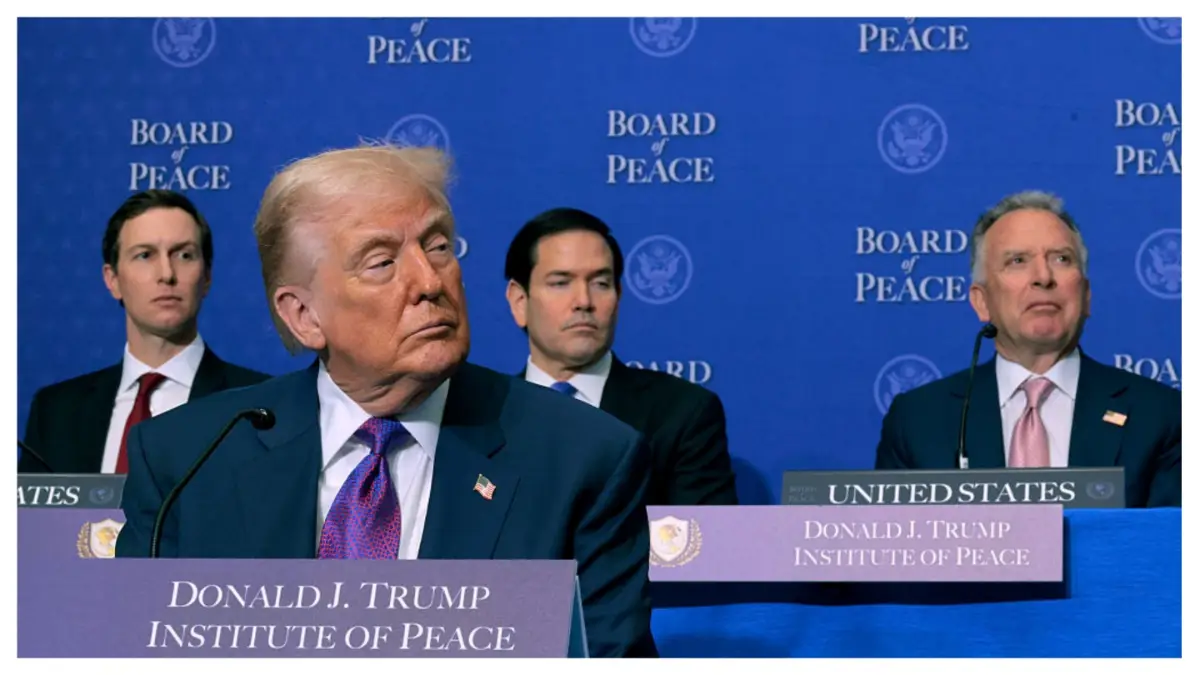
Within Donald Trump’s political orbit, esteem seldom comes without a price and humor rarely travels without consequences. Public praise can function as a tether, and what sounds like a joke often carries a reminder about who draws the lines.
The hierarchy appears malleable only up to a point, and the instant someone seems to acquire independent gravity—even while pushing Trump’s own program—the mood can shift without warning.
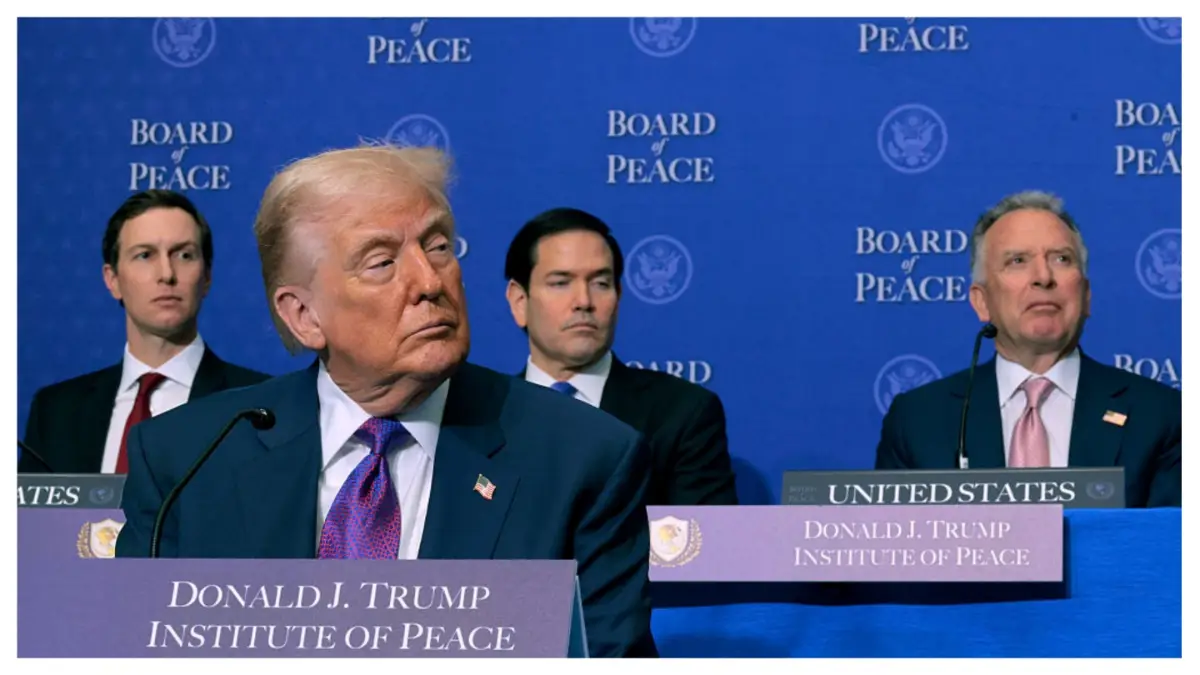
That shift seemed to flicker across Secretary of State Marco Rubio’s face during a Washington public gathering when Trump delivered what could pass for a casual remark, light in tone yet edged with something sharper.
Only days after Rubio’s Munich return drew favorable headlines, sustained applause, and a long standing ovation, the balance of power quietly reasserted itself at the first gathering of Trump’s newly created Board of Peace on Feb. 19.
“And Marco, you really did yourself proud two days ago in Munich—so proud that I almost terminated his employ because they were saying, ’Well, why can’t Trump do this?’” an envious president proclaimed, not obviously joking.
“I do, but I say it differently,” Trump added, before letting slip a veiled threat as Rubio’s anxious reaction registered on camera.
“But Marco, don’t do any better than you did, please, ’cause if you do you’re outta here. But no, I want my guys to do great,” he pressed on.
Social media picked up the nuances in Trump’s comments and honed in on Rubio’s reaction.
“As with everything he says, this is not a joke. Tread carefully, Little Marco,” posted an X user who has used that nickname for Rubio since the 2016 campaign.
That user quipped, “Marco gave one of the most nervous laughs I have ever seen.”
Another observer noted Trump’s envy, saying, “Leader ordinarily loves when his team shines. He hears applause and starts comparing it to his own.”
One viewer summed up the sentiment: “There’s more than one type of compliment, but I hadn’t realized there are nine. Some are called ‘left-handed’ compliments. The one Trump offered Marco seems to be the Envious or Awkward kind. He’s odd and insecure.”
The tension did not exist in isolation.
Earlier, aboard Air Force One, when Trump was pressed about the 2028 ticket in light of Rubio’s Munich reception, he refused to close the door on the idea, instead turning the conversation toward Vice President JD Vance. “It’s something I don’t have to worry about now,” he said, then pivoted to say, “JD is fantastic, and Marco is. They’re both fantastic, I think, really. And I think Marco did a great job in Munich.”
It wasn’t the first time Trump declined to offer Rubio a clean, unequivocal endorsement.
Online, the exchange spurred a separate wave of response—less about policy and more about posture. For some, the moment looked less like unity and more like deliberate ambiguity, the kind that keeps everyone just a notch off balance.
View on Threads
“He’s trying to pit the two against one another. That’s all he does—sow chaos, never solving any issues for Americans,” commented Threads user Jeng Burke.
Another participant added, “Trump makes an adversary out of one and then the other.”
Rubio’s address in Germany on Feb. 14 drew broad applause from conservatives who welcomed his push for stricter border controls, national sovereignty, and what he framed as Western civilizational values. He reassured European leaders that the United States remained committed to partnership, declaring, “We belong together.”
“And so, this is why we Americans may sometimes come off as a bit direct and urgent in our counsel,” Rubio remarked during his half-hour address. “This is why President Trump demands seriousness and reciprocity from our friends here in Europe. The reason, my friends, is that we care deeply.”
The speech carried a diplomatic and restrained tone and earned a standing ovation.
Yet, as The Guardian later noted, the speech amounted to “an offer of friendship — but on white, Christian, Maga terms.”
Beneath the courteous rhetoric lay the same Trump-era themes that Vice President JD Vance had articulated more bluntly at the conference a year earlier: mass migration as civilizational erosion, distrust of international bodies, and warnings that Europe was veering away from “fundamental values.”
In other words, Rubio was promoting Trump’s worldview—only with a touch more polish.
That polish might have satisfied conservatives at home, but it also risked something else within Trump’s inner circle: the perception of eclipsing the man at the top.