
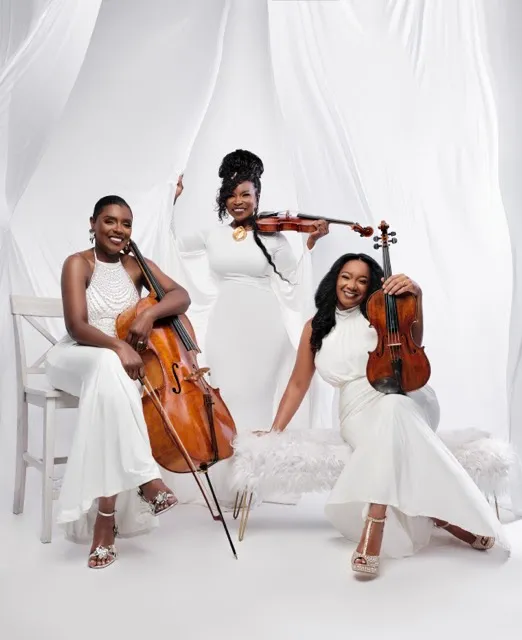
The Push to Create
For nine years, The String Queens cultivated an outstanding reputation as masters of arrangement and fusion. They could transform an Earth, Wind & Fire classic, a classical concerto, or a modern pop hit into a piece that felt meant for violin, viola, and cello. Yet the leap to writing and releasing original music was a hurdle they hesitated to cross.
“Even before this particular year, something was forming inside us—both individually and together—that we needed to release some original music,” Kendall Isadore recalls. “We considered it, we’d been a group for nine years, but we teetered on the edge of, like, ‘we should release it, we should write something,’ yet we wouldn’t quite take that plunge.”
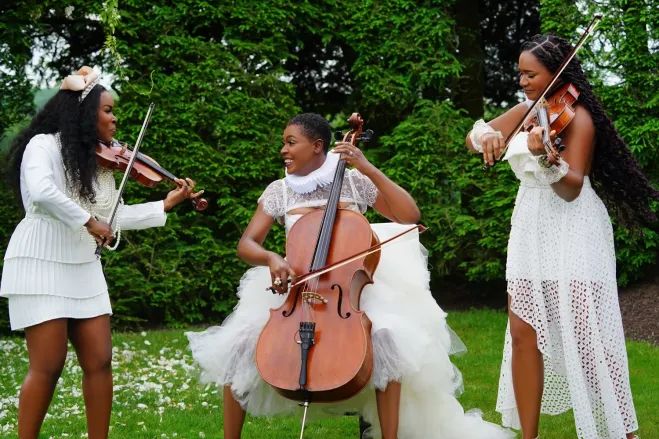
The catalyst they needed arrived in the form of a gentle but resolute nudge from the legendary jazz violinist and NEA Jazz Master Regina Carter. Carter, a pioneer of genre-defying string artistry, gave them the go-ahead they had been seeking.
“She simply told us, ‘just do it,’” Isadore remembers. “Something as straightforward as trying it, taking the leap, is enough. You all possess everything necessary to craft an original piece of music. Whatever you release will carry power, because you approach it with intention and thoughtfulness in your message. She pushed us… She said, ‘you’ve already booked studio time. When you step into the room and the engineer hits record, do what you planned, then let whatever emerges guide you.’”
With Carter’s blessing secured, the trio set to work in the most intimate of spaces—Dawn’s basement.
“We said, ‘OK, we’re doing this now. What does it feel like? What should it sound like?’” Isadore explains. Around the inception of the song, the film Sinners had recently captured the public imagination. Its raw, ancestral imagery, narrative, and music resonated deeply with the trio. “We, as musicians, are also storytellers. The past and our lineage inspired us to create something that honors our ancestors and our families, something the younger generation could connect with.”
Anatomy of a Masterpiece
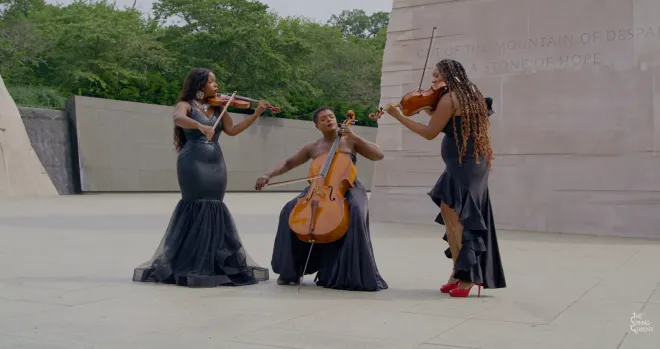
“Troubled Liberty” demands your full emotional attention. The composition opens with a memorable 13-second excerpt from the late poet, author, and activist Nikki Giovanni. In Giovanni’s voice, she draws a parallel between The String Queens and the pioneering Black women of NASA—Katherine Johnson, Dorothy Vaughan, and Mary Jackson—whose brilliance and precise calculations enabled America’s early space missions.
“That comparison struck us as incredibly powerful, not just for me but for all of us,” Dawn Johnson notes. “That’s why we chose to place it at the album’s opening, because it sets the tone and makes a statement. This is the launchpad for the artistry we want to convey, the sound we want to reflect as string players and as Black women.”
Once Giovanni’s voice fades, the instrument-driven storytelling begins, built with deliberate, technical finesse. Cellist Élise Sharp describes the song’s foundation, which begins with a sustaining drone that anchors the entire piece.
“It started with a drone,” Sharp explains. “There’s something about a drone—it’s like a dirge. It centers the work and centers the emotion. It began as a double-stop drone, and then Dawn and Kendall enter with these beautiful, lyrical lines.”
Over that mournful drone, Isadore introduces a haunting rendition of “My Country, ’Tis of Thee,” reframed in a minor key. Before the audience can fully absorb the sorrow of that patriotic melody, Dawn Johnson weaves in the historic Negro spiritual “Wade in the Water.” The result is a deliberate juxtaposition between American idealism and the heavy, ancestral resilience of enslaved Black Americans.
Yet the piece does not linger in despair. Abruptly, the tempo shifts, accelerating into a driving, inexorable pace.
“The listener is drawn toward something,” Isadore explains. “Then we arrive and flip the tempo, and you hear a near-sprint. It makes you wonder: are you running from something or toward something? It invites the listener to interrogate every facet of it, but there’s a hopeful middle section—what I’d call a bridge—that embodies the possibility at the heart of it all. You have the mournful cry of ‘Wade in the Water’ and the less joyful rendition of ‘My Country, ’Tis of Thee,’ yet there’s a sense that the world as it is now won’t endure forever.”
What We Carry
As summer 2026 progresses, anticipation for their forthcoming full-length album, What We Carry, continues to rise. The project promises a genre-defying journey through sound, memory, and identity, honoring the legacy of Black women musicians while embracing the full spectrum of the human experience.
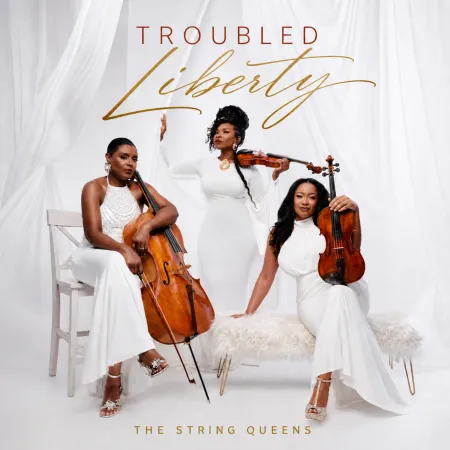
Ultimately, The String Queens view their music as a vessel for deep, spiritual healing—a sanctuary where listeners can release the heavy burdens of the world, even if only for 90 minutes.
“I cherish when listeners are able to simply sit through one of our performances for 75 to 90 minutes and completely forget about every worry,” Johnson reflects softly. “In that moment, the space becomes more than brick and mortar—it becomes a spiritual connection among everyone present.”
She recalls the often-emotional exchanges that take place after a show during meet-and-greet moments.
“We’ve connected with audience members who tell us they hadn’t stepped out of their homes in months, some for more than a year, due to personal losses. They heard about The String Queens from a loved one who had passed,” Johnson shares. “When we’re able to be in that space with people, and for that hour and a half they can forget their cares and reconnect spiritually with their loved one and with the music, that’s what I adore about our shows. We want to ignite a spark that God has blessed us with and pass it on to someone else who can pass it along, letting our sound, mission, love, and message travel the world.”