
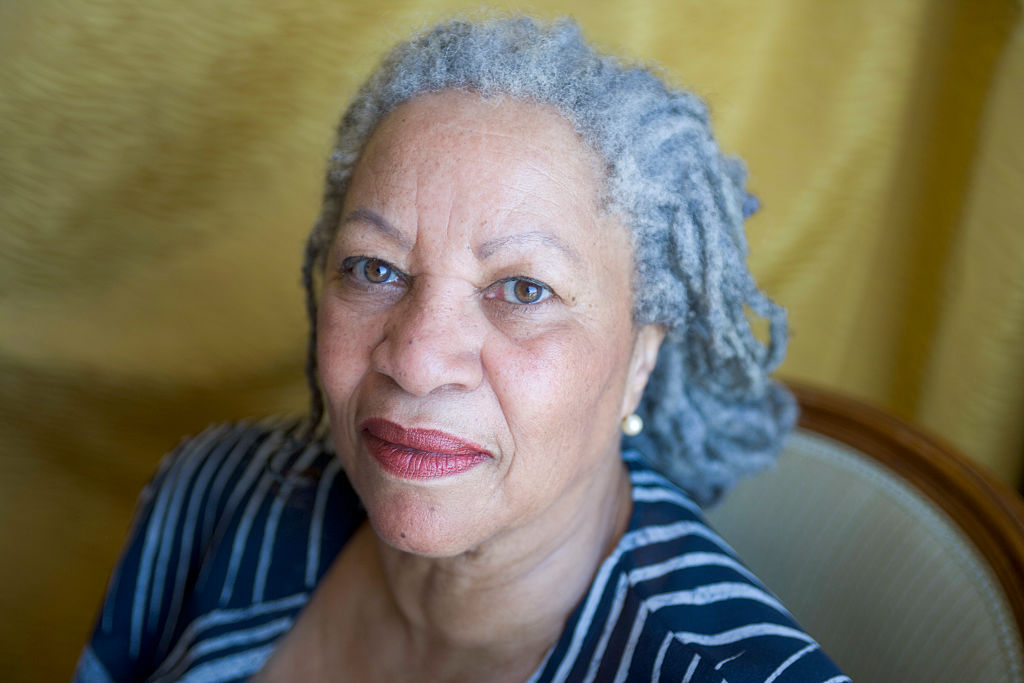
Dear Toni Morrison,
Your name has resurfaced online this week, Toni.
Not because of a long-lost lecture or a freshly unearthed interview, but due to a podcast discussion reevaluating how people talk about your legacy today.
An episode of the Cannonball podcast, hosted by critic Wesley Morris, reevaluates your role in American literature as he describes a renewed “wave of Morrisonia.” The phrase signals the renewed focus on your work through multiple reissues and the emergence of new scholarly work examining your writing.
The episode points to On Morrison, a volume by novelist and scholar Namwali Serpell that delves into the craft of your storytelling and your impact on the American novel.
But Toni, even before many listeners finished the episode, readers began to weigh in.
Before hitting play, I did what many viewers do first.
I scanned the comments.
Almost immediately, responses emerged not only to the argument but to how the discussion was framed.
Love MadameNoire? Get more! Sign up for the MadameNoire Newsletter
We care about your privacy. See our privacy policy.
One viewer, @TØGITR, wrote, “No one would be checking this out if Morrison wasn’t used as click bait. Her genius is not up for debate here.”
Another commenter, @afyt6894, asked the question that seemed to hang over the entire discussion: “Why wasn’t a Black woman included in this discussion? In 2026? A conversation on Toni Morrison without a Black woman’s input is kinda wild.”
That concern kept resurfacing. Some critics label it as misogynoir.
User @rgb3071 wrote, “To discuss Toni Morrison with two individuals who are not Black when disregarding the white gaze was so important to Morrison is puzzling… the addition of a Black woman’s POV was essential.”
Another commenter, @nakiecee15, echoed the same frustration: “Why on Earth is Morrison being discussed WITHOUT a Black woman? There’s an entire perspective that Morrison made sure she centered that is entirely missing from this conversation.”
Not every viewer viewed the episode as dismissive. One commenter, @sexygiraffe4172, called it “a lovely discussion and a moment to remember one of our literary pillars.”
Yet the overall reaction made one thing plain.
People weren’t merely debating literary criticism.
They were defending you.
Wesley Morris Argues Your Image Has Been Raised Too Far
After digesting Morris’s essay and watching the talk, the angle he’s pursuing is unmistakable.
His core argument is that your reputation has expanded so massively that critics hesitate to scrutinize the work itself.
He characterizes you as having attained a “stratospheric” status in American letters, noting that readers now spend more time “gazing at the light around you, at the myth of you,” than actually parsing the sentences on the page.
According to Morris, adoration has tipped into something closer to worship.
He suggests that your work is treated “like a miracle” and that you yourself have been elevated “to a saintly height.”
In Morris’s view, that reverence is the issue.
“Sanctification has risks,” he argues, because it places an artist “up in the sky where we can’t quite reach her.”
The question he finally poses is this: “Who’s touching the work?”
In other words, who is still engaging with the writing rather than revering the legacy?
On the surface, this may read as a fairly conventional literary critique.
But Toni, timing adds a layer of convenience to this worry.
For generations, white male authors from Faulkner to Hemingway have been treated as untouchable giants within the literary canon. Their genius was assumed. Their brilliance seldom appeared as myth.
Yet when a Black woman reaches that same reverence, critics suddenly worry we might be admiring her too much.
That tension helps explain why this conversation landed differently for so many readers.
Your Legacy Was Never About Mythic Image
Because the truth is, Toni, the admiration surrounding your work didn’t emerge from nowhere.
You earned it.
You stood as one of the most influential voices in contemporary American literature and became the first Black woman to receive the Nobel Prize in Literature in 1993.
Across eleven novels, including The Bluest Eye, Sula, Song of Solomon, and Beloved, you reshaped literary norms by centering the inner lives of Black people in ways rarely afforded space in the American canon.
In The Bluest Eye, you revealed how beauty standards can quietly fracture a young Black girl’s sense of self through the harrowing story of Pecola Breedlove.
In Beloved, you faced the intergenerational trauma of slavery with language so haunting that the book eventually won the Pulitzer Prize.
Your work wasn’t revered because people were trying to conjure a myth.
It was revered because you gave voice to truths that American literature had long left unspoken.
As you once wrote,
“Definitions belong to the definers, not to the defined.”
Through your novels, you refused to let Black life be defined by anyone else’s gaze.
Why Readers Still Return for Your Work
Beyond moments like #MelanatedMarch or #WomensHistoryMonth, MadameNoire feels compelled to weigh in. For many Black women readers, admiration for your work has always been less about elevating you and more about recognition.
You gave language to experiences that persisted long before and were too often left out of literary discourse.
Your characters were not mere support figures orbiting someone else’s plot.
They themselves were the focal point of the story.
You once summarized your vocation in a single line:
“If there’s a book you want to read that hasn’t been written yet, you must write it.”
That precisely describes what you achieved.
You authored the books that generations of readers had been longing to find.
Thank You for Writing Us Into the Narrative
So while scholars reexamine your work and podcasts debate your legacy, something quieter continues to unfold.
Readers keep seeing themselves within your stories.
Youthful readers continue to encounter The Bluest Eye and recognize the perils of beauty standards.
Families keep reading Beloved and feeling the weight of history and endurance intertwined on the page.
Writers still regard your work as proof that Black storytelling deserves complexity, lyricism, and room to breathe.
That is why discussions of your legacy rarely stay purely academic.
They feel intimate.
Because for many of us, Toni Morrison, your words were never merely literature.
They signaled recognition. Especially in a culture that still gives Black women very little space, you have always taught us to challenge the status quo.
That is why your readers continue to show up whenever your name is mentioned.
With love and gratitude.

Danielle Brooks
I am a staff writer at New York Beacon, where I focus on culture, entrepreneurship, and the emerging voices redefining Black America. My work highlights innovators, artists, and founders whose stories often unfold beyond mainstream headlines but shape communities in meaningful ways. Through precise reporting and thoughtful storytelling, I aim to document progress, challenge narratives, and contribute to a stronger Black press tradition.