
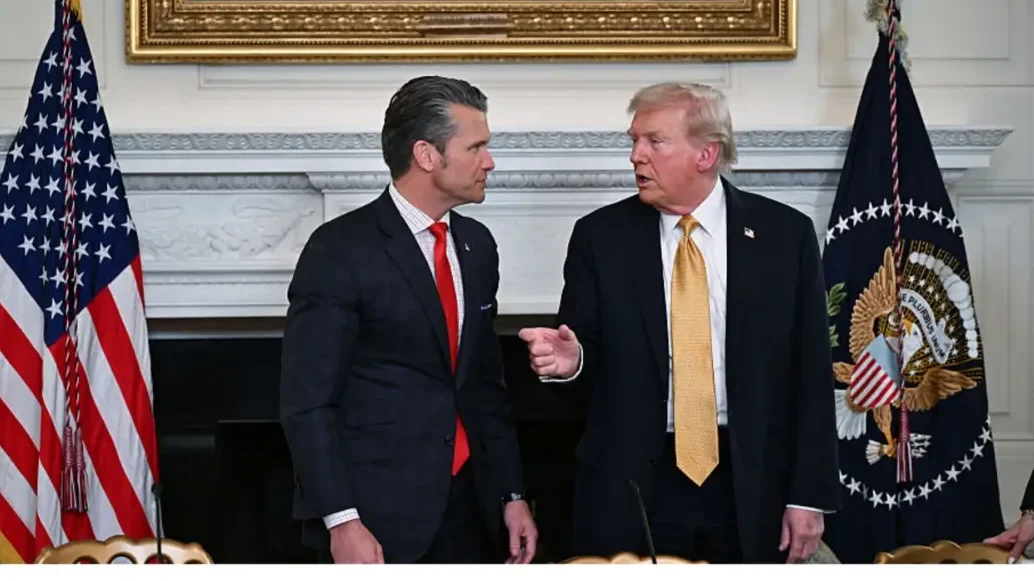
President Donald Trump proclaimed himself above the law in relation to his Iran war — and then his own defense chief Pete Hegseth walked into the Senate chamber and, without intention, tore his entire argument to shreds.
On Friday, May 1, Trump was asked whether he intended to seek congressional authorization to continue the military operation. It has now been sixty days since he launched a campaign against Tehran without explicit congressional approval, a move that could violate the War Powers Resolution.
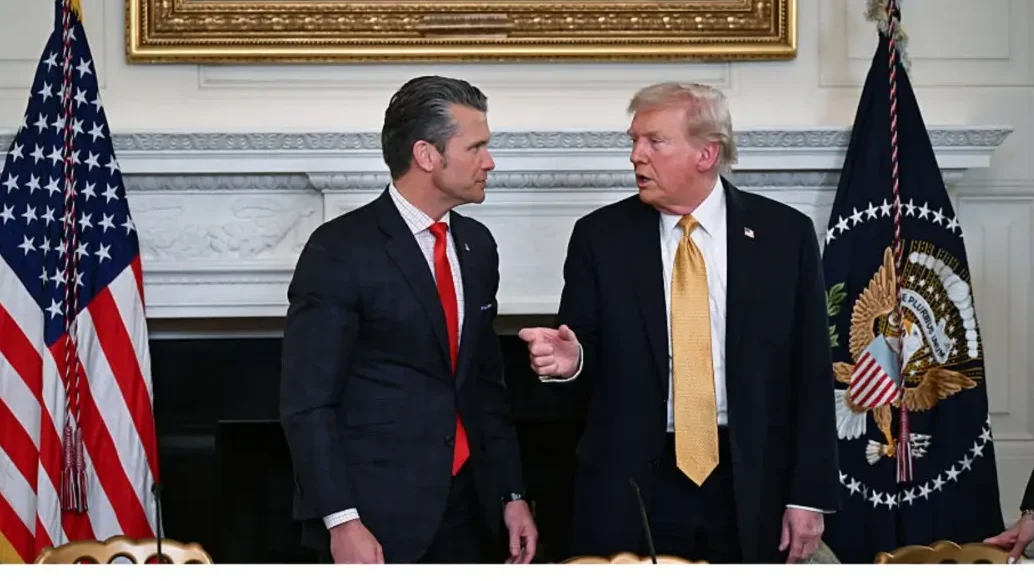
Under the 1973 resolution, a president has two months to secure approval from Congress or request a 30-day extension, and if neither occurs, the administration must halt the military engagement. The law was crafted to prevent exactly what is unfolding now—a president dragging the United States into a military confrontation without the explicit consent of federal lawmakers.
In his reply to the reporter, Trump insisted that congressional authorization was unnecessary.
‘He Never Answered!’: Pete Hegseth Snaps at Congresswoman Demanding Answers on Trump’s Sanity, Then She Unloads Receipts and Watches Him Fold
“No one has ever obtained it before. They deem it wholly unconstitutional, yet we remain in regular contact with Congress. But no one has ever pursued it or requested it before. It’s never been used in the past. Why should we be different?” Trump asserted with a degree of ambiguity.
Although World War II was the last time Congress officially declared war, former President George W. Bush sought congressional authorization for the War on Terror after 9/11 in 2001 and secured it.
Congress also passed a resolution for his father George H.W. Bush’s Gulf War in 1991
In fact, the War Powers Resolution was enacted because presidents across several administrations did not seek congressional approval for the Vietnam War, a conflict that endured nearly two decades.
Then Hegseth adopted a strikingly different approach during testimony before a Senate committee on Thursday, April 30. The top U.S. military official told lawmakers that a ceasefire also implies a pause on the War Powers Resolution deadline for congressional authorization.
View on Threads
“We are in a ceasefire at the moment, which, as we understand it, means the 60-day clock stops or pauses during a ceasefire,” Hegseth asserted with a straight face, perhaps hoping senators would accept that a ceasefire equates to the end of a war or betting they wouldn’t catch the nuance.
Virginia Democrat Sen. Tim Kaine wasn’t convinced.
“We’re right at the 60-day deadline. Is the president planning to either seek congressional authorization or send us the legally required certification showing that he needs an extra 30 days to remove U.S. forces from the conflict?” Kaine pressed back.
“On Iran, ultimately, I would defer to the White House and White House counsel on that. However, we are in a ceasefire right now which our understanding means that the 60-day clock pauses or stops in a ceasefire. It’s our understanding just so you know,” Hegseth talked over Kaine, who issued the former Fox News host a warning.
“I do not believe the statute would back that interpretation. I think the 60 days could run tomorrow, and that would present a very significant legal question for the administration. We have serious constitutional concerns and we don’t want to compound those with additional statutory ones,” Kaine replied.
While Trump was preoccupied with denying that he needed congressional approval to engage in a war, Hegseth appeared to acknowledge the obligations of the War Powers Resolution, shifting the responsibility back to Trump.
A backlash against Trump and Hegseth quickly surged across social media, with frustrated users pointing out the obvious and offering their own takes.
“He has a majority in both houses and yet he’s still afraid they won’t do as he says,” a Threads user observed.
Another cited a line from Abraham Lincoln to make a point. “We the people are the rightful masters of both Congress and the courts, not to overthrow the Constitution, but to overthrow the men who pervert the Constitution.”
On X (formerly Twitter), a user offered a sardonic take: “’This is MY Middle East quagmire and no one’s going to take it away from me!!’ What a total idiot.”
Dark Star remarked, “Only nine weeks left in Trump’s ‘4-6’ week timetable…. Keep at it, Trump, right through October… see how the midterms go.”
Another summed it up this way: “He’s clueless. He’s just making stuff up as he goes.”
Trump launched an unauthorized offensive against Iran on February 28, presenting shifting rationales, aims, and an endgame. He repeatedly claimed the military action would last four to six weeks, even as that deadline had long passed.
With a fragile ceasefire in place, Trump has attempted to negotiate with the Iranian regime to end the fighting, but without success. He has instead blocked Iranian vessels transiting the crucial Strait of Hormuz, which Tehran closed almost immediately after the assault began.
The shutdown has driven global energy prices higher, with the average price of gasoline in the United States rising by 33 cents week over week to about $4.39 per gallon, according to Triple A. It stood at $4.05 a gallon the previous week and had been under $2.00 a gallon in parts of February before Trump’s war.