
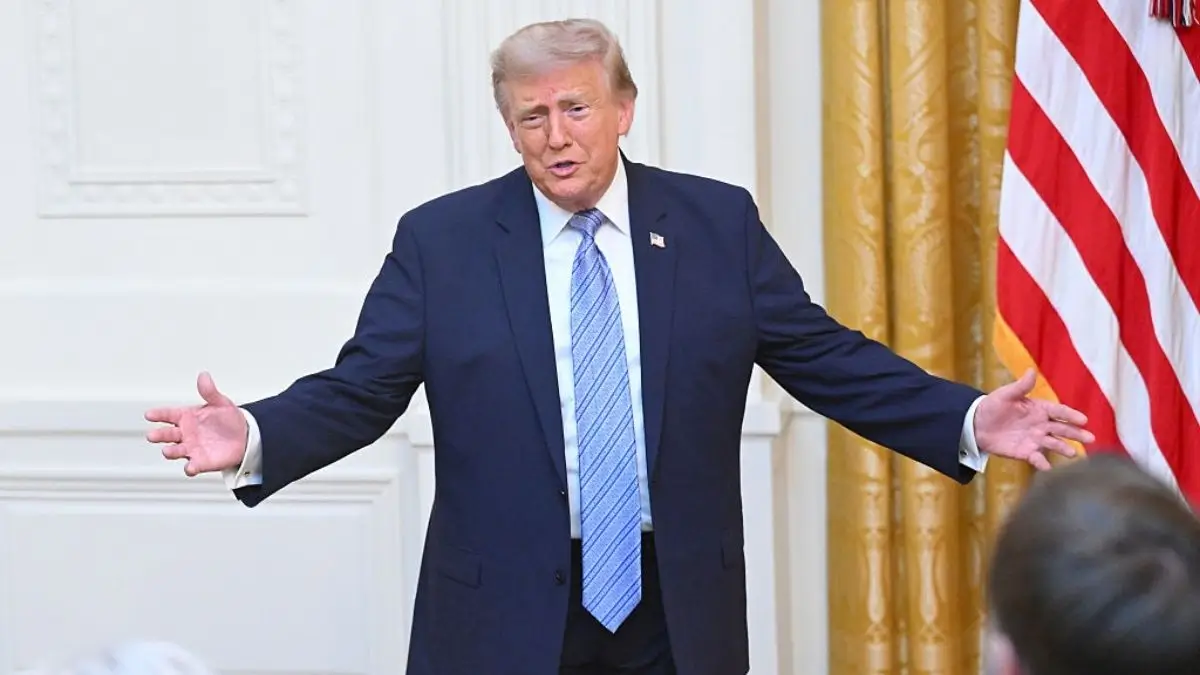
President Donald Trump has released a campaign advertisement that touts his record just weeks before the midterm elections. Yet one line in particular has left viewers stunned.
The spot opens with Trump stating, “Together we will defeat communism, socialism and Marxism in America.”
The president continues as images of him flash across the screen, “America will never be a communist country,” while a JMSN track, “Love Me,” endlessly loops in the background.

The advertisement asserts that Trump was responsible for “the largest tax cuts in history.” It credits him with “reigniting American manufacturing” and asserts that he “defends law and order and police.”
Dana White, the president and chief executive of the UFC, supplies a voiceover in the spot, saying, “He’s the toughest, most resilient person that I’ve ever met, and nothing was going to stop him from fighting so hard for the country he loves.”
But it is the final line that has lawmakers from both parties up in arms: “Paid for the US Government.”
‘Clowns’: Trump’s White House Melts Down Over Report That He Went Rogue, Then Critics Spot the One Thing It Didn’t Deny
The clip cost $14,000 and has been airing on right-leaning networks Fox and Newsmax since Sept. 23, according to The Associated Press.
Many observers question the political nature of the ad, despite Trump presenting it as a nonpartisan message.
In a statement, the White House described it as a “public service announcement” and said it was “educational and unapologetically patriotic.”
“These public service announcements are about reminding Americans to love their country and understand what makes it worth defending, at home, at our borders, and abroad,” the statement continued.
Social media erupted with protests, with many wondering whether the commercial is even legal.
“Is this not illegal?” asked an X user. X poster Diane McKenna pointed out, “So basically the taxpayer footed the bill for this.”
Another X user offered a different take. “This ad is blatant THEFT of government funds for electoral propaganda. Bill Mr. Trump and prosecute him!”
The post echoed a familiar MAGA-era refrain from the 2016 campaign, but this time the words were reversed: instead of “lock her up,” the message read “Lock him up!”
Maryland Representative Jamie Raskin argued on X that the ad violates the Hatch Act.
“This may be felony criminal theft and conversion of government property for political campaign purposes,” the Democrat wrote.
“It is a Hatch Act violation for any government employees who worked on it or used government resources to make it,” he added.
“It is blatantly unethical under numerous federal ethics provisions proscribing the use of government resources for political campaigns,” he concluded.
If Democrats regain control of the House in November, Raskin could chair the formidable House Judiciary Committee.
Republicans also voiced displeasure.
Louisiana Senator John Kennedy told the AP that he does not “like to see politicians use public money to pay for their own campaign ads.”
They were not the only critics. The track behind the ad, “Love Me” by JMSN—real name Christian Berishaj—disavowed the use of his song, according to The Hill.
Berishaj posted his objection on X: “To anybody who has followed my career and knows what I stand for and built my career on, it should go without saying that I would never authorize my music to be used for ANY political agenda or campaign.”