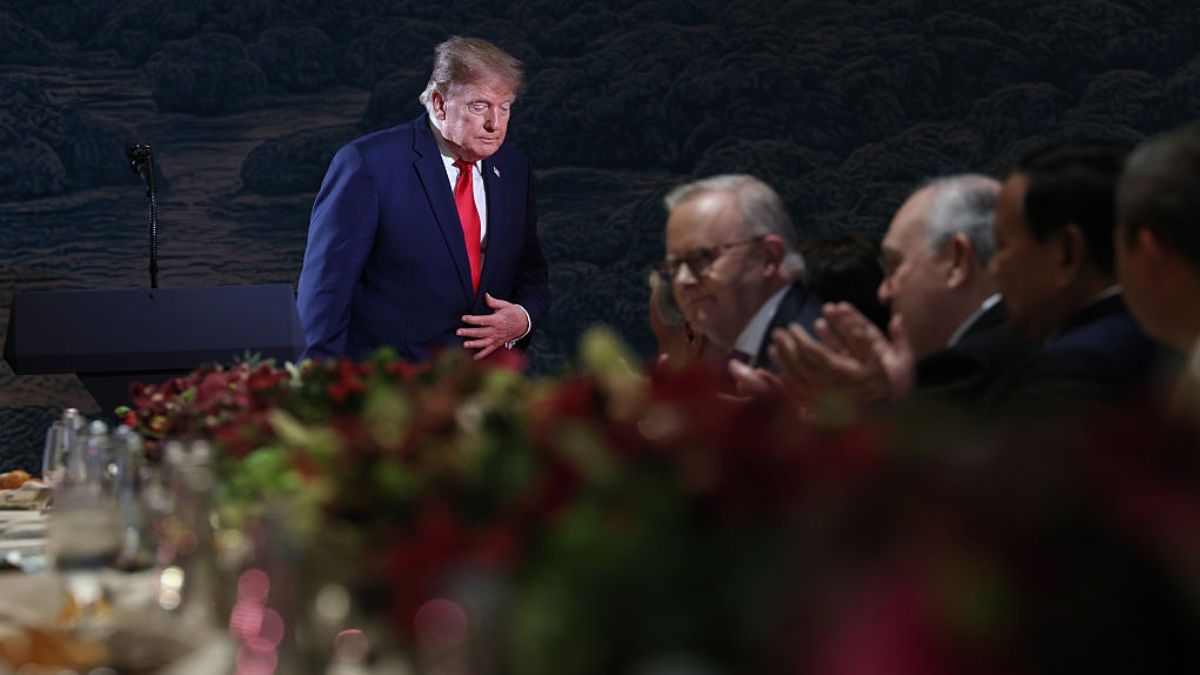
Last year, affluent backers were practically clamoring for a seat at his dinner table, with some even spending millions to buy into his $TRUMP memecoin simply to gain an invitation.
The president enjoyed his glamorous evening, his guests could boast about their presence, and his family’s cryptocurrency business reaped a substantial windfall.
Now, Trump is preparing to host another exclusive dinner at his Virginia golf resort on November 22, and the turnstiles may not be as far from closing.
Floyd Mayweather, former NBA star Tristan Thompson, and Shark Tank’s Kevin O’Leary are listed among the touted attendees. Organizers say the event is sold out.
But this time, the excitement surrounding the gathering appears noticeably different.
Invitations weren’t sold as ordinary tickets. Investors had to buy and retain enough cryptocurrency to climb a leaderboard and qualify for the exclusive dinner.
Yet more than 5,000 eligible investors chose to opt out of the competition this year, according to The Washington Post.
Organizers even extended the registration window by four days, but interest remained tepid.
One investor qualified with only $518 in holdings. By contrast, last year’s qualifying threshold started around $55,000, with some participants investing millions.
Yahoo! News readers learned about the bleak turnout and quickly added their two cents with jokes.
“DJT can’t fill a 350 seat gala, WHAT does HE need a BALLROOM for?” one person asked. Another chimed in, “Not hard to write sold out. Maybe he meant he was a sell out.”
Last year’s gathering drew enthusiastic reactions from some high-profile attendees.
Former NBA star Lamar Odom praised Trump, while crypto billionaire Justin Sun celebrated attending. Investor Kendall Davis also defended his decision to attend despite protesters accusing Trump of selling access to the presidency.
“I don’t feel any type of remorse for coming here,” Davis told NBC News at the time. “Nobody in my family has ever ate with the president.”
That earlier enthusiasm has since cooled. The irony is hard to ignore: the memecoin gala may show as sold-out, yet the market behind it tells a far different story about the crowd showing up for Trump’s dinner.
“Even his rallies this year were two-thirds empty,” one observer wrote. Another joked, “Are these the same people who brag about 10,000-person rallies with lines wrapped around the block at venues that only seat 3,000?”
The numbers help explain the mood shift. Trump’s memecoin was launched in January 2025 and quickly reached a market capitalization of $10 billion. Its price later rose above $73 before plummeting to under $1 this month.
Reuters reported that the latest competition drew a mere 130 wallets holding a combined $8.6 million, a 94% drop from the $148 million tied to the first promotion.
A New York Times analysis also found that nearly 989,000 investors had lost a combined $3.81 billion through June 2026.
The Trump clan, however, has enjoyed a considerably different financial trajectory.
Its cryptocurrency ventures generated substantial revenue, including about $635 million in royalties tied to the memecoin and more than $500 million from World Liberty Financial token sales.
Eric Trump and Donald Trump Jr. helped broaden the family’s digital-asset enterprises, while Barron Trump reportedly encouraged his father’s growing interest in cryptocurrency.
When critics tie the surge to the Queens-born former president becoming president, they may be onto something.
World Liberty Financial initially struggled to attract investors during Trump’s 2024 campaign for the White House. His electoral victory, however, helped turn the venture into a substantial wealth generator for his family.
But not everything bearing Trump’s name was selling well.
His 2025 annual financial disclosure, released in June, showed more than $2 billion in income from his business interests. Much of that income stems from cryptocurrency, though some merchandise lines have faltered.
Revenue from Bible sales declined from $1.3 million to $208,486, while earnings from sneakers and fragrances dropped from $2.5 million to just $67,634. Watches, however, bucked the trend, with revenue rising to $4.47 million.
After years of financial setbacks, including casino bankruptcies and dwindling revenue at some properties, Trump found another lucrative market.
Forbes’ latest assessment places Trump’s current net worth at about $6.3 billion, down from $7 billion in September. He was estimated to be $2.7 billion wealthier than when he secured the 2024 presidency, per Forbes’ September figure.
When CBS pressed Trump about his rising wealth, he appeared irritated. Rather than giving a straightforward explanation, he suggested that rising markets were making everyone wealthier.
The exchange underscored the contrast between Trump’s growing fortune and the losses shouldered by investors. The way the dinner was marketed has sparked backlash, with many questioning the event’s ethics.
“Isn’t that a bribe? You had to buy his coin in order to attend???? Con man!!! Everything he touches is destroyed, even our democracy,” one Yahoo! reader complained.
According to Reality Tea, Sen. Adam Schiff and eight Democratic colleagues have questioned whether the dinner constitutes a pay-to-play arrangement.
The White House maintains that attendees receive no government favors as a result of taking part in the dinner.
Trump still has a dinner to host. But investors who once spent fortunes chasing a seat aren’t lining up in the same way anymore.
Dinner with President Trump costs $518
At the most recent dinner for solana:6p6xgHyF7AeE6TZkSmFsko444wqoP15icUSqi2jfGiPN holders, one of the attendees had a purse worth exactly that amount
Cryptocurrency. Results https://t.co/wI0akbEhlA
— Dippy.eth (@dippy_eth) November 22, 2026