

For years, President Donald Trump has operated within a tightly managed orbit where allies reinforce his version of events and uncomfortable truths seldom break through. Critics argue that this arrangement helps explain how he can repeatedly declare victory even as polls, economic indicators and public sentiment point in a different direction.
Yet that insulation is being tested in ways it never has before. Trump’s escalating confrontation with Iran — undertaken without congressional authorization, without the backing of key partners and now showing signs of strain — is colliding with a reality that’s proving harder to corral as pressure mounts both abroad and within his inner circle.
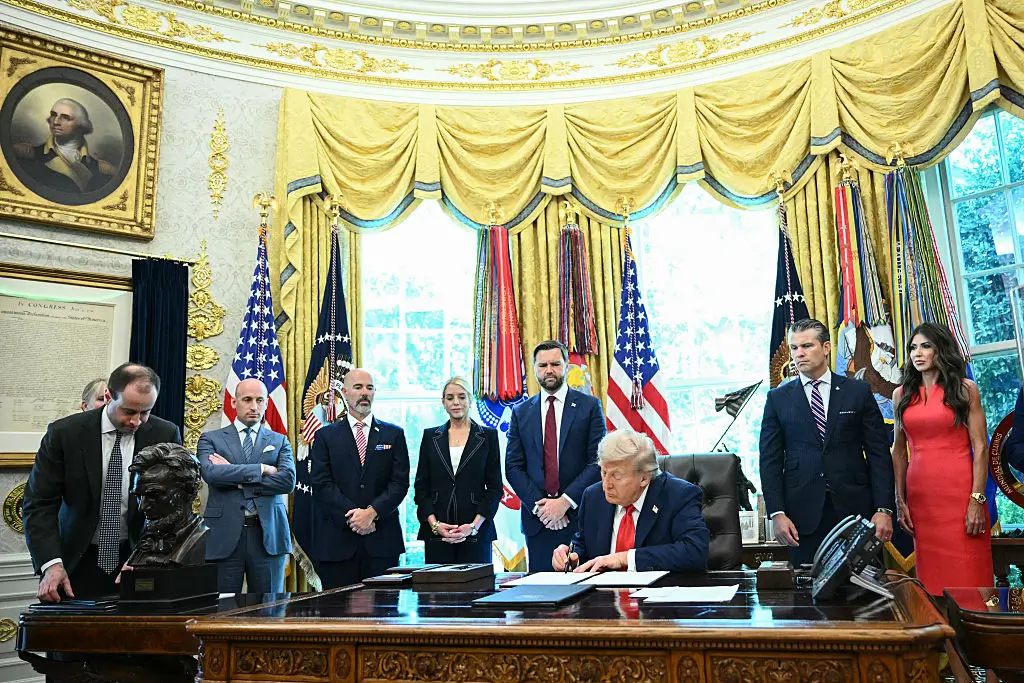
That pressure is now appearing at the highest echelons of Trump’s inner circle.
According to a Time report, White House chief of staff Susie Wiles is growing increasingly alarmed by the course of the conflict and the narrowing set of options, with sources saying she believes aides have been giving the president a far too optimistic reading of the situation even as opposition grows and the costs of the war keep rising.
‘This Is Necessary’: Trump Casts JD Vance Aside Over Iran — Yet Vance May Hold the One Card That Could Turn This Against Trump as Some Conservatives Push Him to Go There
Widely regarded as Trump’s right-hand with respect to this war, Wiles maintains that aides are not telling the president the truth, but instead what he wishes to hear.
Wiles — who previously managed the campaign for Trump’s ally in this conflict, Israeli Prime Minister Benjamin Netanyahu — reportedly urged colleagues to be “more forthright with the boss” about the risks of an extended confrontation in the Middle East, spanning both economic and political fronts.
Polls repeatedly show the conflict is unfavored by a majority of Americans, including MAGA supporters.
Wiles reportedly grew concerned after the president’s own pollster, Tony Fabrizio, conceded that public opinion had shifted against the war.
Social media erupted over the report, with speculation that Wiles is already preparing for the worst while some people did not grant her a free pass.
“As much as I detest Trump, I detest his sycophantic enablers even more. They bear a share of responsibility for the mess Trump has created in Iran. They at least possess their wits. Trump clearly does not,” one observer wrote.
“She sees the end approaching and has begun pulling back from the chaos,” another Threads user noted.
Another agreed, “The reputation rehabilitation for the once-insane Susie has begun in earnest.”
This commenter added bluntly, “So if Susie Wiles is so worried, why hasn’t she done something about it? To know and do nothing makes her a deceitful and complicit White House chief of staff.”
During the 2024 presidential campaign, Trump pledged to put America first, keep the nation out of foreign conflicts, and ease inflation and consumer prices for consumers.
On February 28, he launched an unauthorized strike against the Islamic Republic that left 13 Americans dead, hundreds wounded and more than 2,000 Iranians killed.
But some analysts argue it’s the surge in gas prices and the plunge in stock indexes that actually shifted voters’ views. Gas prices surpassed $4 a gallon, a $1.50 rise in under a month, while crude crude rose above $111 a barrel.
Iran retaliated by striking at its Gulf neighbors and sharply constricting traffic through the strategic Strait of Hormuz, the narrow passage that links the Persian Gulf to the open sea and moves about 20 percent of the world’s oil daily.
Trump and his inner circle were said to be unprepared for Tehran’s vehement countermoves. A displeased president is upset by the developments and Americans’ negative perception of the war, Time reported.
Iran’s response also surprised Defense Secretary Pete Hegseth, who was described as being taken aback by events, a characterization the department denies.
Yet another unnamed source contradicted the Pentagon’s account, telling Time, “There’s no question.”
Other sources, including two members of Congress, indicated Trump is seeking an “off-ramp” but one that would allow him to declare victory.
In a disjointed primetime address to the nation on Wednesday, April 1, Trump spoke in mixed terms, saying he was winding down the war and that it was “nearing completion,” only to immediately threaten that the U.S. military would strike the country “extremely hard” in the coming weeks with the aim of destroying Tehran’s energy grid.
“We’re going to bring them back to the stone ages where they belong,” Trump proclaimed.
This inconsistent messaging and shifting objectives have characterized Trump’s public rationale for striking Iran from the outset and is a big part of why a broad swath of Americans oppose a war they don’t understand and which the president has struggled to justify coherently.