
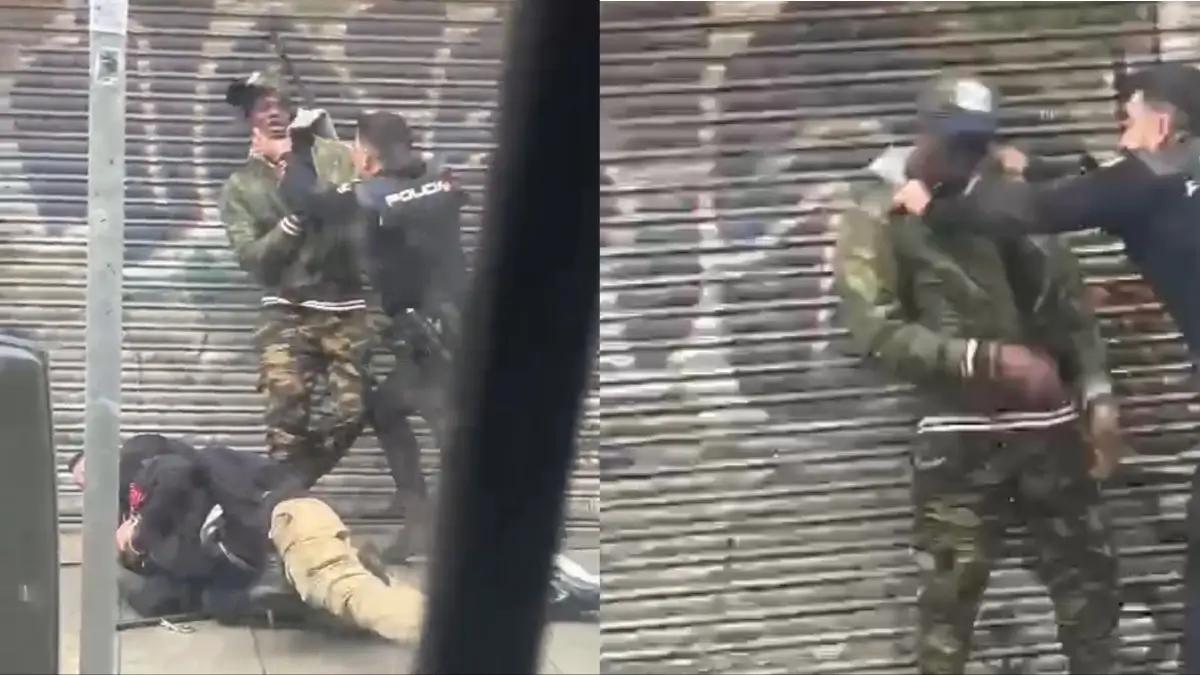
Two white officers from Spain’s national security forces are facing a federal probe after a video surfaced showing two unarmed Black men being assaulted and brutalized in a Madrid neighborhood near the city center, Lavapiés, late last month. The footage prompted nationwide outrage and accusations of racism from many citizens.
The viral clip, recorded on March 29 in Lavapiés and later circulated widely on the platform X, depicts a troubling street confrontation in which the officers appear to be the aggressors, according to several public officials who reviewed the footage.
The video shows one officer pinning a person to the ground in a chokehold while another officer strikes the restrained man twice with a baton, then turns his attention to a second man nearby who had pleaded with the officers to stop, punching him in the throat without asking any questions.
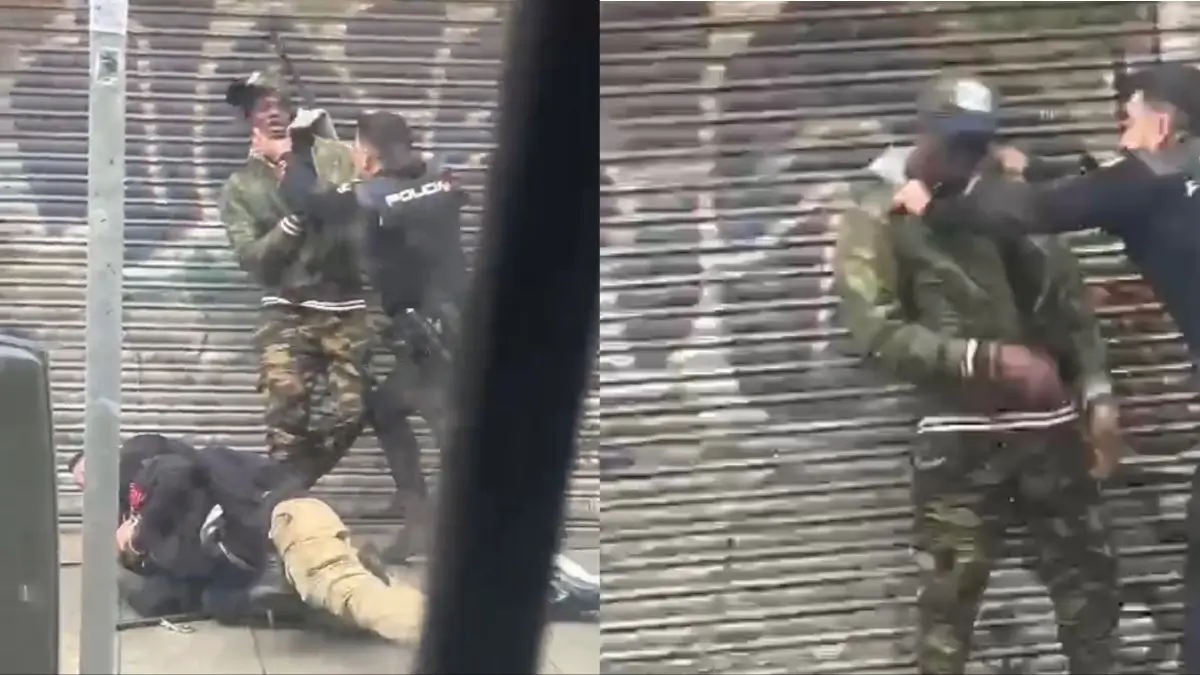
After viewing the clip, several national lawmakers voiced their outrage and called on Spain’s interior ministry to investigate the officers involved.
“This police violence is unacceptable,” said Isabel Serra, a spokesperson for the Podemos party, in a post on social media. “And unfortunately — or because of the complicity of institutions — it is all too common. It is racism.”
Íñigo Errejón, a spokesperson for the Sumar left-wing alliance, added that he demanded a written explanation from Spain’s National Police Corps. “Do not normalize this, do not look the other way, ask for explanations,” he wrote on X.
As the two scuffles intensified, the man on the ground did not resist arrest, and at one point he loosely stretched his arms as two more officers hurried past, chasing the other subject, who briefly managed to slip away from the backup officer.
The man in the chokehold appeared to give up as the officer tightened the neck grip, and that is where the footage ends.
Some observers on social media noted that the officer maintained a firm hold for an extended period, yet there was no evident attempt to handcuff the man or to explain the reason for his detention.
During a parliamentary session last week, Errejón highlighted that the clip seemed to show two officers behaving aggressively toward the men—one apparently immobilized and the other not resisting but trying to shield himself from the blows. “The conduct of the officers looks cruel and does not appear to align with the rules governing police conduct,” he said, urging the interior ministry to clarify whether an investigation had begun into the officers’ actions.
“What will be done about the complaints from residents of Lavapiés about police violence against migrants?” he asked, echoing coverage in the Guardian.
In the wake of the video, hundreds of demonstrators converged on Lavapiés square to protest police brutality and systemic racism.
“This is something we face every day,” stated Serigne Mbayé, a former regional politician who now serves as the anti-racism secretary for Podemos, in a video from the protests posted online. “Thanks to a neighbor who recorded this, the police brutality that is commonplace in this neighborhood is now visible.”
In later remarks, Mbayé urged the government to intensify its fight against racism and to push the state policing agency toward greater transparency in cases of misconduct.
“We are telling the government to take action; this cannot continue,” he said. “We are in Spain, in the 21st century. Everyone has rights.”
On April 1, the Interior Ministry announced that its national office for human rights—established in 2022 to ensure state forces respect fundamental rights—was investigating the incident.
There are several versions of the footage from different angles, uploaded by witnesses onto social media, though most clips are under a minute and do not show what led up to the violent episode.
Later, a police source cited by Europa Press said the two Black men were arrested for disrespecting authority, labeling their actions as “hostile” toward the officers, one of whom sustained injuries during the confrontation, which appeared unprovoked.
The police source also claimed that one of the detainees was allegedly found with drugs, but no details were provided and the charges could not be confirmed immediately.
The video sparked outrage across Spain, with SOS Racismo, an anti-racism group, labeling the footage “another example of how state security forces act in Lavapiés.”
In a social media post, the organization stated, “Those of us who live in this neighborhood know that these actions are common, and nobody takes action against them.”
The two victims of the police assault have not been publicly identified, and there was no information on the injuries they might have sustained during the incident.
The episode occurred less than a week after Brazilian winger Vinícius Júnior broke into tears at a news conference while detailing a pattern of racist abuse he continues to endure in Spain, despite being one of Real Madrid’s most prominent Black football players.
He said racist encounters have become part of daily life in Spain and that he had come to expect encountering bigotry throughout the country.
“When will it be enough?” he wrote in a recent social media post. “Racism is a crime. Failing to punish is to be an accomplice.”
For many Black Americans, Spain is seen as a dream vacation spot, but beneath its charming exterior lies a troubling history of racism that often goes unnoticed by tourists.