

Brazil’s Ministry of Foreign Affairs issued apologies to the embassies of Canada, Gabon, and Burkina Faso after an incident in which three Black teenagers — later identified as the offspring of foreign diplomats — were subjected to gunpoint detentions and body searches by federal police, despite having committed no offense.
The profiling episode surfaced when one mother, whose child in the group is Brazilian, posted security footage of the encounter on social media, provoking nationwide outcry as such experiences have become routine for many young Black youths in Rio de Janeiro.
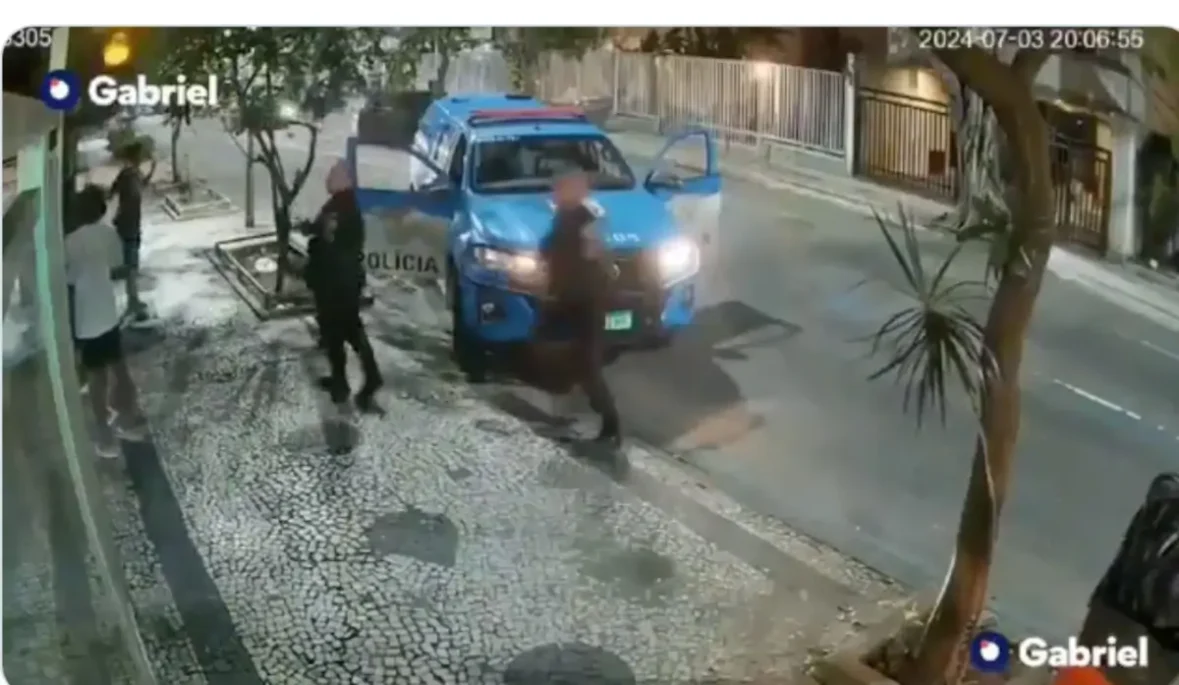
At least four teenagers, possibly a fifth, were targeted in the latest incident — three were Black and one was white — after the group arrived in Rio for a five-day vacation to celebrate the end of the school year.
Unbeknownst to the police officers, the Black children are sons of ambassadors from Gabon and Burkina Faso, while another Black teen in the group is the son of a Canadian diplomat.
The white students they were with live in Rio but attend classes with the Black students in Brasília, 724 miles away.
The fresh-faced friends, all 13 and 14 years old, were traveling for the first time without their parents and were emotionally scarred after police pressed guns to their heads without provocation or reason.
During a meeting at the foreign ministry in Brasília last week, government leaders moved swiftly to address the shocking episode, extending a formal apology to the ambassadors of Gabon, Burkina Faso, and Canada in a bid uphold the country’s reputation on the world stage despite persistent domestic racial tensions.
The ministry called on Brazil’s government to conduct a “thorough investigation and ensure appropriate accountability of the police officers involved in the incident,” the Guardian reported.
Rio’s military police, which handles patrol duties, announced that body camera footage from the incident would be analyzed to determine whether the officers used excessive force. The civil police also assigned two of its units to investigate the case.
International observers criticized Brazil’s policymakers for their inadequate response to such incidents, allowing overt racism to fester within the ranks of the nation’s police force.
“There’s nothing besides racism to explain the attack these Black teenagers suffered,” said Jurema Werneck, Brazil’s executive director for Amnesty International, according to the Guardian.
She underscored that racism in Brazil primarily targets people “in the favelas, outskirts, poor and Black communities.”
“Unfortunately, the brutality suffered by these teenagers is not the first and, sadly, won’t be the last,” she said. “In Brazil, no young Black person is safe.”
The encounter happened Wednesday night, near the affluent neighborhood of Ipanema. As the group walked home from a day at the beach, a military patrol unit pulled up abruptly behind them on the sidewalk.
Two officers jumped out with guns drawn and commanded the boys to get up against the wall to be searched.
Rhaiana Rondon, the mother who later shared the video of the episode, said the Black teens were singled out for pat-downs, while the officers mostly disregarded the two white teens with them.
Rondon said the footage clearly depicted her son and his cousin receiving different treatment compared to the Black kids.
“The officer guided my son much more gently because he is white, while the three Black youths had guns pointed at their heads,” Rondon said, according to the Guardian.
In a statement to lawmakers, the Black teens said they were humiliated when the officers forced them to expose their genitals to check them for drugs.
Eventually, officers let the kids go, shaken but alive.
Before departing, the agents warned the teens not to wander around Rio lest they face another search or worse.
“The footage, testimonies, and the children’s accounts are clear: the search was racist,” Rondon concluded.
Julie-Pascale Moudoute-Bell, the wife of the Gabonese ambassador, told TV Globo that she was appalled by the incident and demanded that the officers be held accountable.
“The police are there to protect. How could they point guns at the heads of 13-year-old boys?” she asked. “We trust in the Brazilian justice system and we want justice, that’s all.”
A recent report revealed that of the more than 1,300 individuals killed by the police in Rio, 87 percent were Black— a stark contrast to the state’s 58 percent Afro-Brazilian population.
Rondon said the teens remain traumatized by the incident.
“On Thursday, they saw the same patrol car passing by, got really scared, and hid in an ice cream parlor,” said the Brazilian mother. “When they hear a siren now, even if it’s from an ambulance or the fire brigade, they get scared.”
Brazilian journalist Guga Noblat shared a post to X, claiming that his nephew was one of the teens targeted by state police in the incident. He also shared a message from his sister-in-law about what happened.
“The approach was RACIAL and CRIMINAL!!” the post reads. “We’ve been going to Rio for years and I’ve never seen anything like this in the Ipanema square with my children. It’s a seemingly safe place. Depends on who!!!”