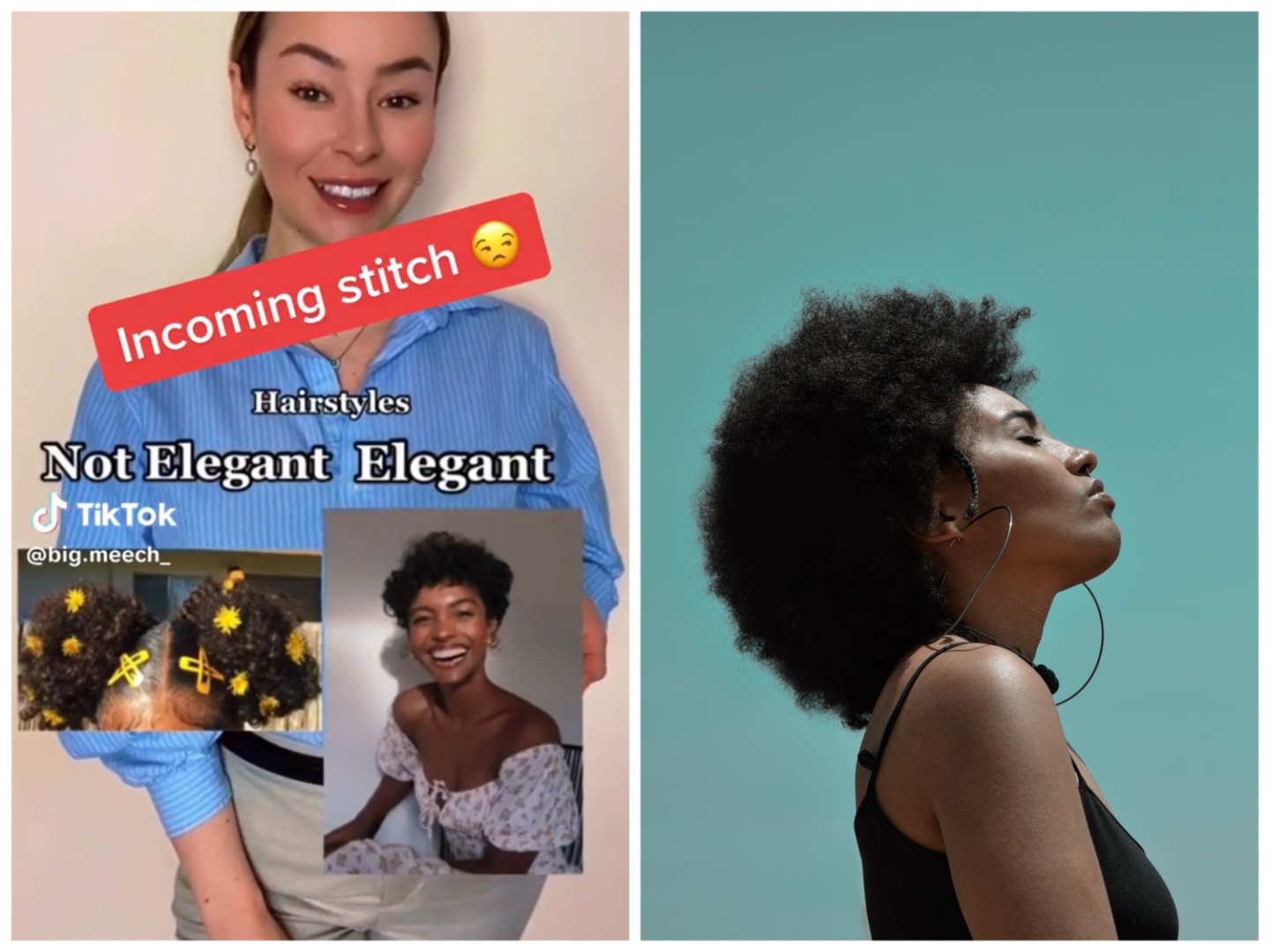
A clip featuring a white woman evaluating hairstyles traditionally worn by Black women sparked widespread controversy online, largely because she labeled certain looks as “elegant” and others as not elegant.
The footage was uploaded by a TikToker going by the handle @Amira.Bessette, who counts close to 350,000 followers and promotes herself on the platform as an “Elegance and Etiquette Coach.”
Throughout the clip, she contrasts and compares styles such as afro puffs, short curly hair, bantu knots, low kinky-curly buns and ponytails, as well as long, flowing waves. She decisions which ones, in her view, qualify as elegant and which do not. She designated bantu knots and afro puffs as “not elegant.”
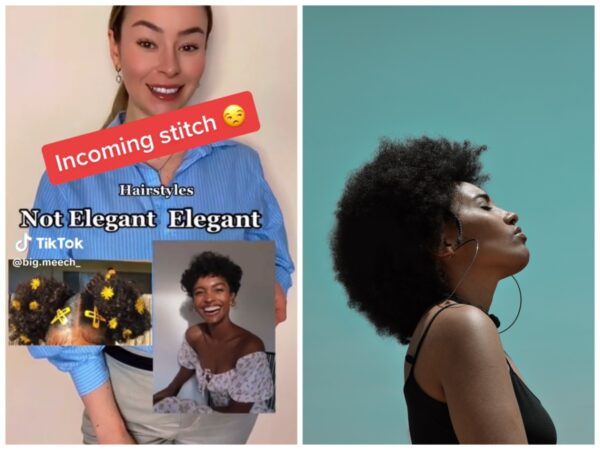
The clip was eventually removed, but not before it circulated widely online, with other TikTok creators stitching the video and users recording screen captures to share it across various platforms.
Related: ‘What’s Wrong with Your Hair?’: An Alabama Woman Was Fired from Her Job After Two Days Because of Her Locs. Now the Company Must Pay Her $800K
Observers who viewed the original clip noted that @Amira.Bessette stated she would not apologize, arguing that she “was trying to be inclusive.”
In a stitched response to the original clip, TikTok user @big.meech_, also a white woman, condemned the material and urged an apology to the Black community.
She delivered a pointed critique, explaining why the video harmed a group that has historically faced various forms of discrimination, including against their natural hair. She also called out the coach’s uninformed actions and the hurtful effect the video had on Black women and men.
“Either you are completely ignorant of how Black people, and Black women in particular, have historically and continue to be policed for their natural hair, or you are aware and still posted the video,” @big.meech_ states in her video response.
“Every hairstyle you showcased in your video was beautiful. Since when are Bantu knots not elegant? Styled puffs can’t be elegant? And who are you to decide what is elegant, especially regarding Black hair? You are so far out of your lane.”
Dozens of users spoke out against the video, with some arguing that the post undermines inclusivity while others condemned Western interpretations of Afrocentric styles.
“We don’t need anyone else to speak on our hair,” wrote one commenter.
“She deliberately selected images of Black women to antagonize us,” another person commented. “She isn’t subtle. There is nothing inclusive about what she did.”
“The Western notion of “elegance” is already a racist concept in itself,” another commenter wrote beneath the post, adding, “There were literally kings and queens with our hairstyle that they call ‘ghetto.’”
“The fact that she spent time browsing the internet and screenshotting these Black hairstyles just to be hateful—lol the misery she inhabits,” another remark noted.
In 2023, Dove partnered with LinkedIn to commission a workplace study that found Black women’s hair is 2.5 times more likely to be perceived as unprofessional, and that more than 20 percent of Black women aged 25 to 34 have been sent home from work because of their hair. Black women with coily and textured hair are also twice as likely to encounter workplace microaggressions compared with those with straighter textures.
In a related 2021 study by the beauty and personal-care brand, it was found that young Black children also experience hair discrimination in school settings.
The study revealed that 53 percent of Black mothers report their daughters have faced racial discrimination based on hairstyles as early as age five. In addition, 66 percent of Black children in predominantly white schools have faced hair-based racial discrimination; 86 percent of those children have encountered it by age 12; and 81 percent of Black children in majority-white schools say they sometimes wish their hair were straight.
All of the Black elementary school girls in majority-white schools who reported hair discrimination experienced it by age 10.
The CROWN Act nationwide campaign began in 2019 to ban hair discrimination in school and workplace environments. States began introducing bills to prohibit discrimination based on hair texture or hairstyle in workplaces and K-12 public and charter schools. California was the first state to enact formal legislation that year, with nineteen other states subsequently adopting and enacting similar laws.
As for federal action in the United States, the House of Representatives advanced a federal measure last year that would have made the act national law. Despite bipartisan support, the bill stalled in the Senate.