
During President Donald Trump’s second term, loyalty tends to reveal itself less through quiet accord and more through the force with which it’s performed. The people closest to him don’t merely echo his message; they package it, sharpen it and, at times, push it beyond its starting point.
That dynamic has fostered a kind of competitive edge inside the administration, where the true currency isn’t restraint but how far someone is willing to push the narrative before anyone else does.
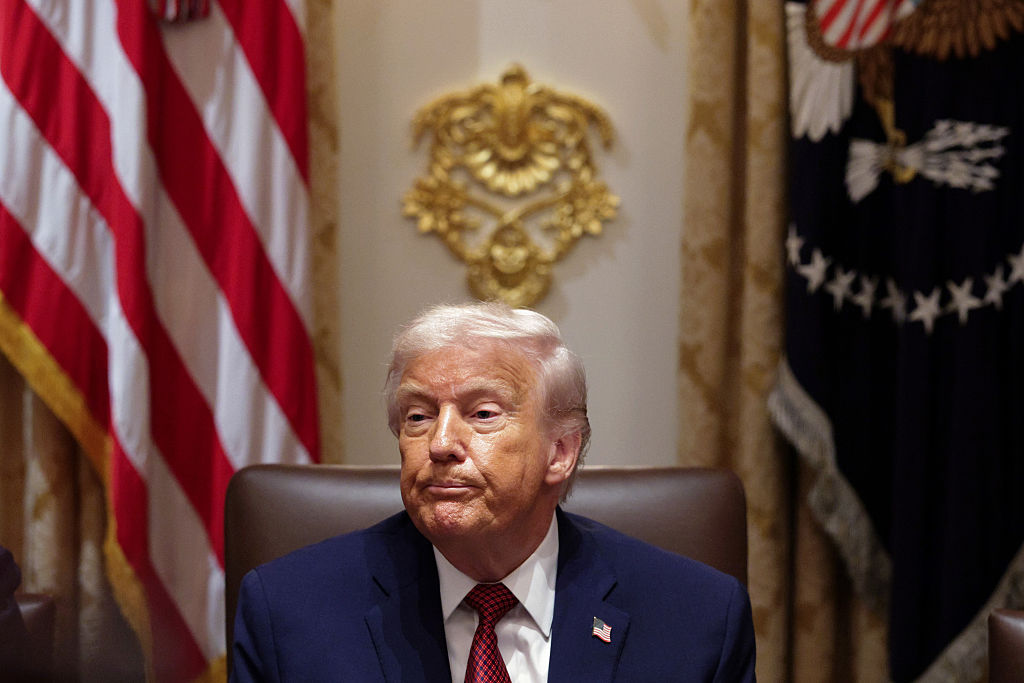
Robert F. Kennedy Jr., one of the more surprising additions to Trump’s inner circle, now finds himself in that position. Once a critic and political rival, he is playing a notably different role, attempting to explain Trump in a way that invites more questions than it answers.
Recounting a 2024 campaign flight, he described sitting with Trump, discussing Syria over a meal of McDonald’s and Diet Coke, when Trump allegedly seized a placemat, flipped it over, and sketched the Middle East from memory — outlining borders, nations, even troop levels.
‘He’ll Be Fired’: Pete Hegseth Squirms as Trump Goes Off Script to Humiliate Him — Setting Him Up to Take the Fall Over Iran War
The room took it as evidence of Trump’s uncanny ability to recall details most assume he doesn’t know. Online, it was met with a collective eye-roll, followed by a chorus of skeptics insisting, “yeah, right—let’s see it.”
The cringe-worthy moment quickly became a case study in how political praise can backfire.
Kennedy used the anecdote to argue the president possesses deep, overlooked knowledge and empathy.
But instead of mending Trump’s image, the story collided with years of public doubt about his grasp of basic facts, turning Kennedy into the butt of ridicule and raising fresh questions about credibility, loyalty, and the limits of political flattery in the social media era.
Speaking onstage at CPAC in Grapevine, a Dallas suburb, on March 28, Kennedy said Trump has “encyclopedic, molecular knowledge across a wide range of interests.”
He added, “Trump’s knowledge is so vast it’s invisible to the human eye.” The lines were meant to lift Trump beyond his bumbling public persona. But in attempting to recast Trump, Kennedy may have walked himself into trouble.
Within hours, social media users began dissecting the claim with stunned disbelief.
One widely shared post read: “NO WAYYYY RFK Jr. just said Trump grabbed a placemat, flipped it over, and drew a perfect map of the Middle East from memory — including the troop strength of every country along every border. With a SHARPIE. This is next-level glazing, the likes we’ve never seen outside North Korea before.”
The tone quickly escalated from skepticism to outright contempt and mockery.
One user mused, “Then why don’t he do it live in oval office infront of cameras on a white board? Like he gave a boob job to hurricane lol. What a pos.”
“RFK is a subservient turd. Every f—king thing this administration won the election on has failed or never come to fruition, and many cases, have done the total opposite of what they campaigned on. You are witnessing the worst presidency in American history,” one user wrote on X.
Another mocked, “Trump is a narcissist. If he could do that, he would’ve done it on camera at least 12x already.”
The backlash drew strength from a long paper trail of moments critics say undercut Kennedy’s claim.
George Conway, a conservative lawyer who has frequently criticized Trump, previously cataloged what he describes as repeated geographic errors.
Conway has pointed to instances where Trump appeared to confuse regions, misunderstand time zones, or reference countries that do not exist. In one account, Trump mixed up the Baltics and the Balkans during a meeting with European leaders, creating confusion that rippled through diplomatic circles.
Those criticisms extend beyond old anecdotes. In early 2025, Trump publicly stumbled through a description of the BRICS nations, misstating membership and suggesting the group had fallen apart when it had not.
Weeks later, he incorrectly linked the bloc’s acronym to Spain and expressed uncertainty about whether China was even part of it.
More recently, Trump appeared to confuse Iceland and Greenland during remarks tied to his threats to seize the island from Denmark, triggering global alarm and even prompting a lobbying push by Icelandic officials seeking clarity in Washington. The incidents have reinforced a narrative among critics that Trump’s knowledge of global affairs is uneven at best.
That history is part of why Kennedy’s story spread so quickly — and why it met such resistance.
The very notion of Trump mapping geopolitical realities on the back of a fast-food placemat was vivid enough to invite parody. It also echoed past controversies, including the infamous “Sharpiegate” episode, when Trump displayed an altered hurricane forecast map, raising questions about who controlled the information and how it was presented.
The effort to reframe Trump left Kennedy looking eager to curry favor, with critics casting him as the butt of the joke: “Word is that RFK is in danger of losing his job, so I guess he’s ramping up the bootlicking in a desperate attempt to continue to do his part in making this country worse,” one commenter wrote.